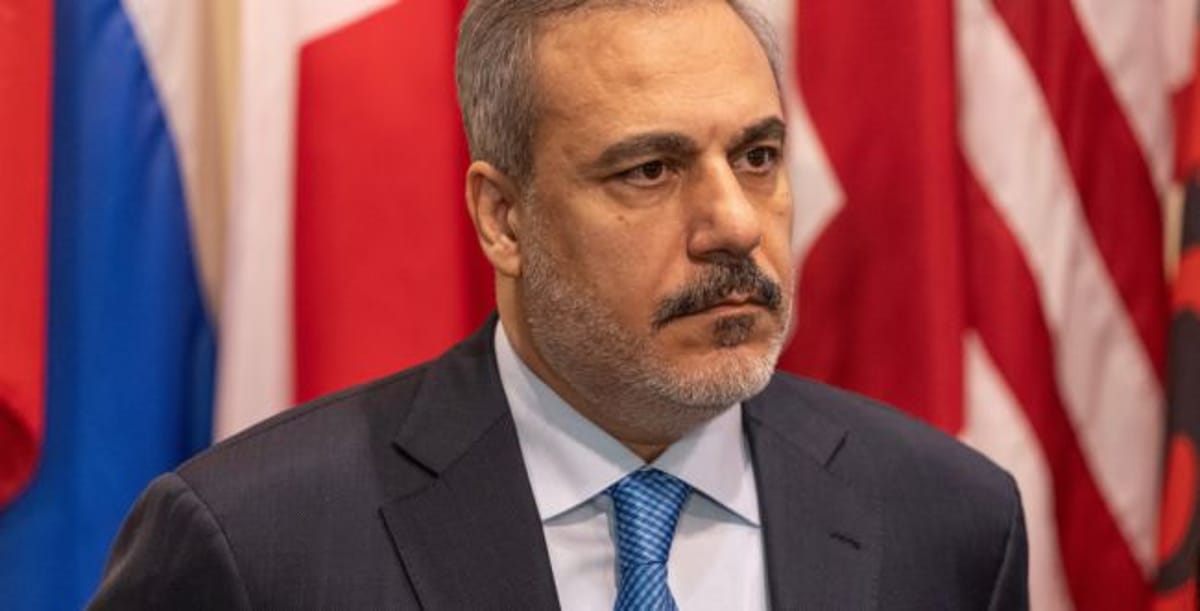
As the United States continues to flood the Middle East with stealth fighters and carrier groups, Turkey has emerged as a prominent voice of caution, warning that military force will not achieve the desired political results in Tehran. Foreign Minister Hakan Fidan, speaking on the current tensions, stated that while an immediate war may not be on the horizon, the region is completely incapable of handling a full scale war between Washington and the Islamic Republic. Turkey’s position is rooted in the belief that "regimes do not change through air strikes" and that only a comprehensive diplomatic settlement, primarily focused on the nuclear issue, can prevent a regional catastrophe. This stance has put Ankara at direct odds with the "maximum pressure" advocates in the Trump administration who see military action as a viable tool for regime collapse.
The Limits of Air Power
During an extensive interview with CNN Türk, Hakan Fidan analyzed the current buildup and the potential for an American strike. He expressed a cautious optimism that a war is not "immediate," but he was clear that military intervention would be a strategic failure. "I do not think there can be a regime change in Iran. A regime does not change through air strikes," Fidan stated. He argued that instead of bringing democracy or a new government, such attacks would likely cause the region to spiral out of control, leading to a war with no clear end point.
Turkey’s President Erdogan has reportedly shown "maximum sensitivity" to this issue, directing his diplomatic corps to use every available channel to prevent an escalation. For Turkey, the solution must be political. Fidan suggested that if a resolution is found for the Iranian nuclear program, many of the other regional problems, including the activities of various proxy groups, could be solved through a ripple effect of stabilization. However, he warned that the current path of military posturing ignores the lessons of the past.
Diplomacy vs. The "June War" Precedent
A significant part of Turkey’s skepticism regarding current American intentions stems from previous experiences where diplomacy was used as a cover for military action. Fidan recalled a specific instance from the war in June, where a scheduled round of talks was ignored in favor of a surprise attack. "During the June war we received a phone call from the US that said: 'Tell the Iranians that within a few hours everything could happen.' I spoke with my Iranian colleague and he said: 'How can this be? We have scheduled talks.' The one who spoke was the US and the one who attacked was Israel," Fidan revealed.
This memory informs Ankara’s view of the current negotiations in Oman. While Fidan acknowledged that messages are being passed through the Omani Foreign Minister and that Iranian Foreign Minister Abbas Araghchi has kept Turkey updated on the talks, there is a deep fear that these diplomatic channels may once again be bypassed for a military strike. Fidan concluded that a war between Iran and the United States would be a "black hole" for the Middle East, destroying decades of development and regional security. Turkey’s message remains clear: the path to a different Iran is through the slow work of diplomacy, not the swift and unpredictable violence of an aerial campaign.