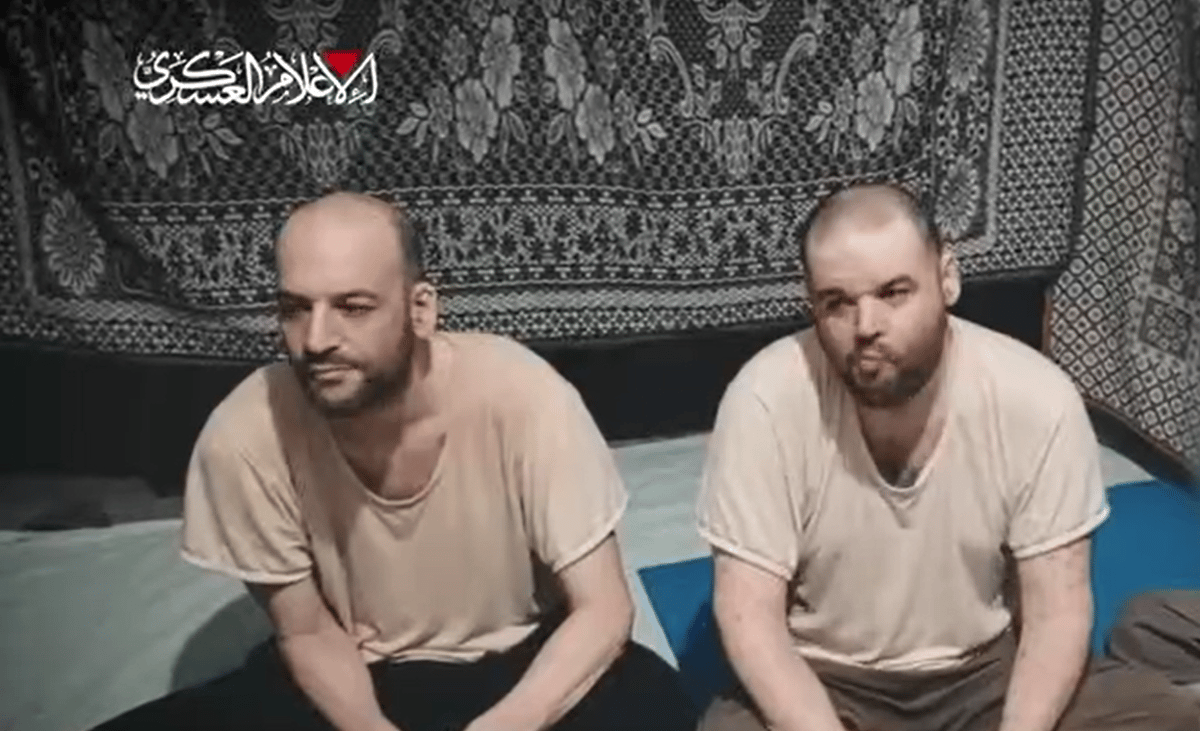
For the first time since returning from the depths of the Gaza Strip, Eitan Horn has shared the harrowing and inspiring story of his two year struggle for survival. Alongside his brother Yair, who was released several hundred days earlier, and their middle brother Amos, the Horn family is finally whole again. Eitan’s journey is one of extreme physical and mental endurance, involving over 700 days in a subterranean world he describes as more developed than the city above. His testimony offers a raw look at the psychological warfare used by Hamas terrorists, the bond of brotherhood that refused to break under pressure, and a profound message of gratitude to the Israeli public whose protests he believes prevented his execution.
The nightmare began on October 7 at Kibbutz Nir Oz. Yair recalls sitting in the safe room as terrorists fired into the door. In a final act of protection, Yair opened the door with his hands up, trying to "inflate" his body to hide Eitan, who was sitting in the corner. Despite his efforts, both were taken. For the first two weeks, they were held separately, until a chance encounter in the tunnels brought them together. "I saw him from a distance," Eitan recalls. "We quickly realized we must not say we are brothers or show we wanted to meet." Yair realized Eitan was being held with women and children, a group treated slightly better than the men, and kept silent to ensure his younger brother wasn't moved to harsher conditions.
Eitan describes the Hamas tunnel network as a sophisticated "city" that was planned for years. "Underneath is a city more developed than the one above," he says, noting that the terrorists knew exactly how to exploit Israeli weaknesses. The movement between these tunnels was grueling. Eitan recounts one 12 hour march through tunnels so narrow they had to crawl. "I told them 'leave me there, that’s it, enough.' And no one gave up. For 12 hours, Saguy, with half a leg and no hand, pushed me too." The terrorists frequently used psychological torture, making jokes about who would be released and who would be executed, all while reminding the captives that any rescue attempt would end in their immediate death because the tunnels were rigged with explosives.
To survive the "Hamas diet," which caused Eitan to lose 64 kilograms, the brothers relied on dark humor. Yair would ask Eitan if he remembered to soap his belly button before and after their rare showers, a small joke that helped maintain their sanity. Eitan also learned to navigate the whims of his captors. "I did everything I could without harming my values or my country," he explains. "I let them laugh at me, that I’m stupid, I danced for them. If after that we got two more dates, I did my part."
The most difficult moment came on day 498, when a deal was struck that included Yair but not Eitan. Hamas terrorists cruelly filmed the brothers' parting, a video Eitan describes as cynical and heartbreaking. "I am very happy my brother is going out, but it makes no sense that they are separating families," Eitan said in the footage. For Yair, the day of his release was the worst day of his life because he knew exactly whose hands he was leaving his younger brother in. Amos, the brother who remained in Israel, described the feeling as "celebrating and cursing in the same breath."
Eitan remained in the tunnels for another 240 days after his brother’s release. He credits his ultimate survival to the Israeli public who took to the streets in mass protests. The terrorists would tell the hostages about the "mess" in the streets, which Eitan interpreted as a sign that their lives still had value to the state. "The government signed and agreed, but I live thanks to the people," Eitan emphasizes. "Hamas understood that the people of Israel care about the captives and want them alive."
Now in the midst of a long physical and mental rehabilitation process, Eitan sees it as his duty as an educator and a Zionist to tell his story so the world knows what they endured. He expresses deep gratitude to the soldiers who spent two years away from their families and to the citizens who refused to let the issue of the hostages fade. For Eitan, every small moment of his new life is a victory. "Nothing now is taken for granted after October 7," he concludes.