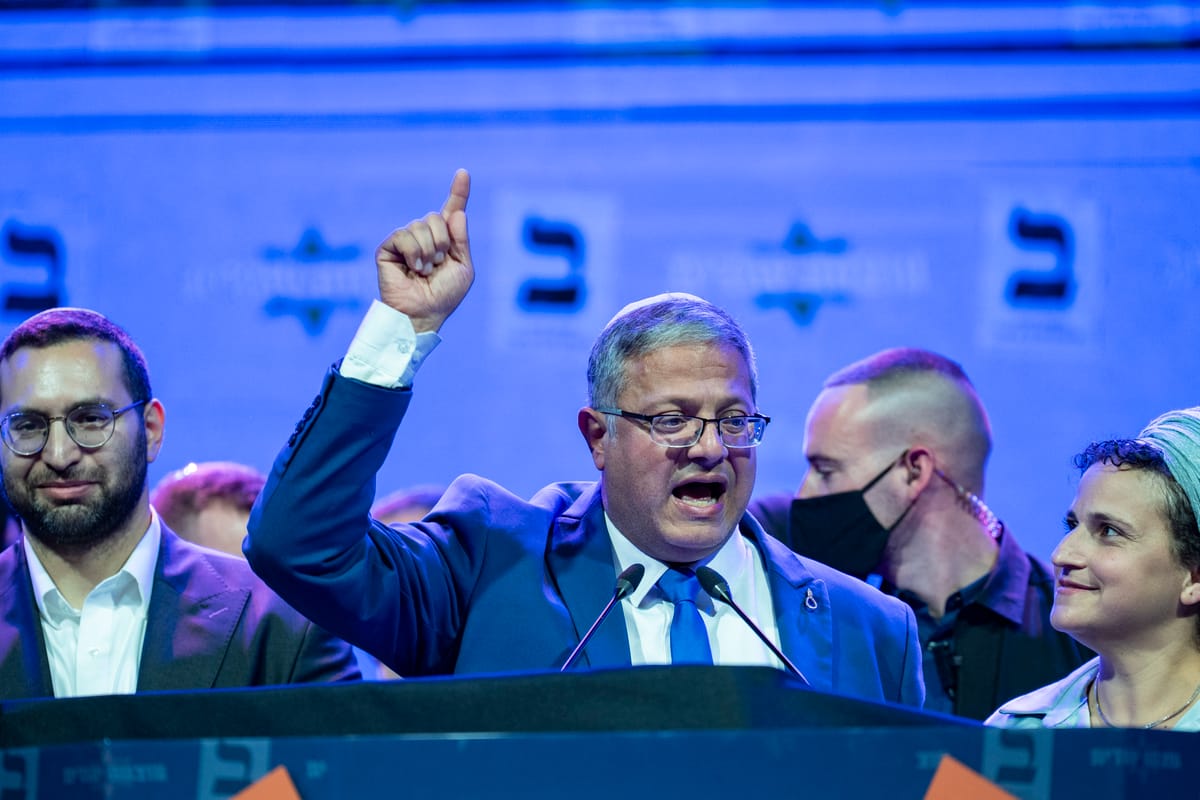
National Security Minister Itamar Ben-Gvir’s Otzma Yehudit party fell well short of its goals in Tuesday’s Knesset election, with exit polls projecting six to seven seats after Ben-Gvir had hoped for double digits, according to Ynet.
Exit polls published by Channels 11, 12 and 13 projected six seats for the party. Kan 11’s initial poll gave it seven, before an updated projection lowered it to six as Likud climbed to 27 seats.
The result leaves Otzma roughly where it stood when the Knesset dissolved in July, when it held six seats. However, it falls below pre-election polling. Earlier this month, JTA reported that Otzma was the only coalition party gaining ground, with surveys projecting it could reach as many as nine seats.
The Jerusalem Post reported that the coalition bloc’s results fell short of pre-election projections, in which Likud trailed Gadi Eisenkot’s Yashar party. The paper suggested that some voters in Prime Minister Benjamin Netanyahu’s bloc may have shifted their support to Likud rather than Otzma Yehudit.
The shift followed a deliberate Likud effort in the final weeks of the campaign to consolidate right-wing votes behind the ruling party. Ben-Gvir publicly criticized the campaign, according to Arutz Sheva, and rejected the argument that right-wing voters should back Likud to ensure it remained the largest party.
About ten days before the election, Ben-Gvir accused Likud of trying to reduce Otzma to five seats and warned that the strategy endangered right-wing rule. “If you harm Otzma Yehudit, you could cause our voters to stay home,” he said at the time. Likud denied his accompanying claims.
Otzma also ran independently in this election, without joining forces with other parties, Ynet reported. In 2022, Otzma and the Religious Zionist Party ran on a joint ticket and won 14 seats together. This time, the Religious Zionist Party ran with Moshe Feiglin’s Zehut and was also projected at around six seats.
Record turnout may also have played a role. Turnout reached its highest level in decades, including a significant rise among Arab voters, which increases the number of votes needed per seat and can weigh on the totals of smaller parties.
Addressing supporters at his party’s headquarters in Modi’in late Tuesday night, Ben-Gvir highlighted his record in government and said the party was proud of the reforms it had promised and worked to deliver. He also warned against any unity government with Eisenkot, calling such a scenario “a terrible mistake.”
Exit polls are preliminary, and final results are expected to be certified on Nov. 4.