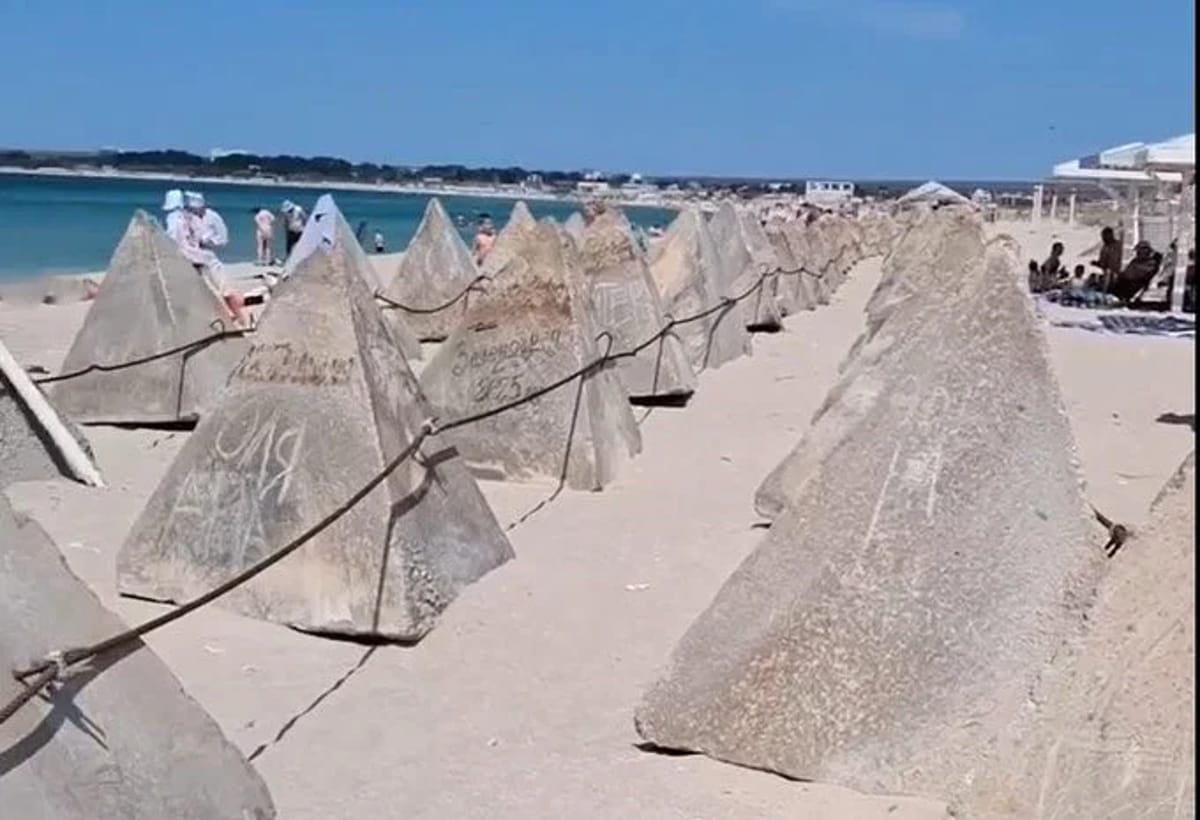
What was once the crown jewel of Soviet-era beach tourism, a stretch of coastline that Russians called their riviera, has been quietly transformed into a military fortification zone. Russian forces are installing "dragon's teeth" anti-tank obstacles on Crimea's beaches just as the summer tourist season begins, and the images emerging from the peninsula are striking: pyramid after pyramid of reinforced concrete jutting from the sand, where beach umbrellas used to stand.
What Are Dragon's Teeth?
Dragon's teeth are anti-tank pyramid-shaped concrete defense obstacles, each standing roughly 90 to 120 centimeters, about four feet, tall. They are a weapon of a different era, first used during the Second World War to impede the movement of tanks and mechanized infantry, designed to slow down and channel armored vehicles into killing zones where they could be destroyed by anti-tank weapons. The Germans used them extensively on the Siegfried Line. Now they are appearing on Black Sea beaches in 2026.
From Riviera to Frontline
Russia has been fortifying Crimea's coastline out of fear of Ukrainian amphibious landings, placing dragon's teeth, mine barriers, and trenches along beaches near several coastal villages. The fortifications are part of a sweeping military makeover of the peninsula. Russia's defensive works across occupied Ukrainian territories, including Crimea, consist of networks of trenches, minefields, razor wire, metal anti-tank barricades, and dragon's teeth, and have been described by Western think tanks as the most extensive defensive works in Europe since the Second World War.
For ordinary Russians who have made the journey to Crimea, one of the very few beach destinations still accessible to them under wartime conditions, the sight has been a rude shock. Visitors have complained that the concrete obstacles ruin the view, block access to the water, and fill the sand with grey, menacing barriers where there was once a postcard-perfect coastline.
The contrast is hard to ignore. Where tourist resorts, promenades, and beach bars once defined the Crimean summer, communication trenches and defensive fortifications have now taken their place.
Moscow's Calculation
The transformation is deliberate. Russia appears to have made a strategic decision to treat Crimea no longer as a tourist asset but as a military priority, a forward fortress on the Black Sea front line. Dragon's teeth and other obstacles have been placed near trenches and defensive positions across Crimea and other occupied areas as Moscow prepares for the possibility of a direct Ukrainian assault on the peninsula from the sea.
The irony is not lost on observers: Russia annexed Crimea in 2014 partly on the strength of its emotional and cultural appeal to Russians as a cherished holiday destination. Now the beaches that were supposed to symbolize the rewards of that annexation are being buried under concrete.
The pyramids are there for the summer. Whether any tourists will be joining them is another question.