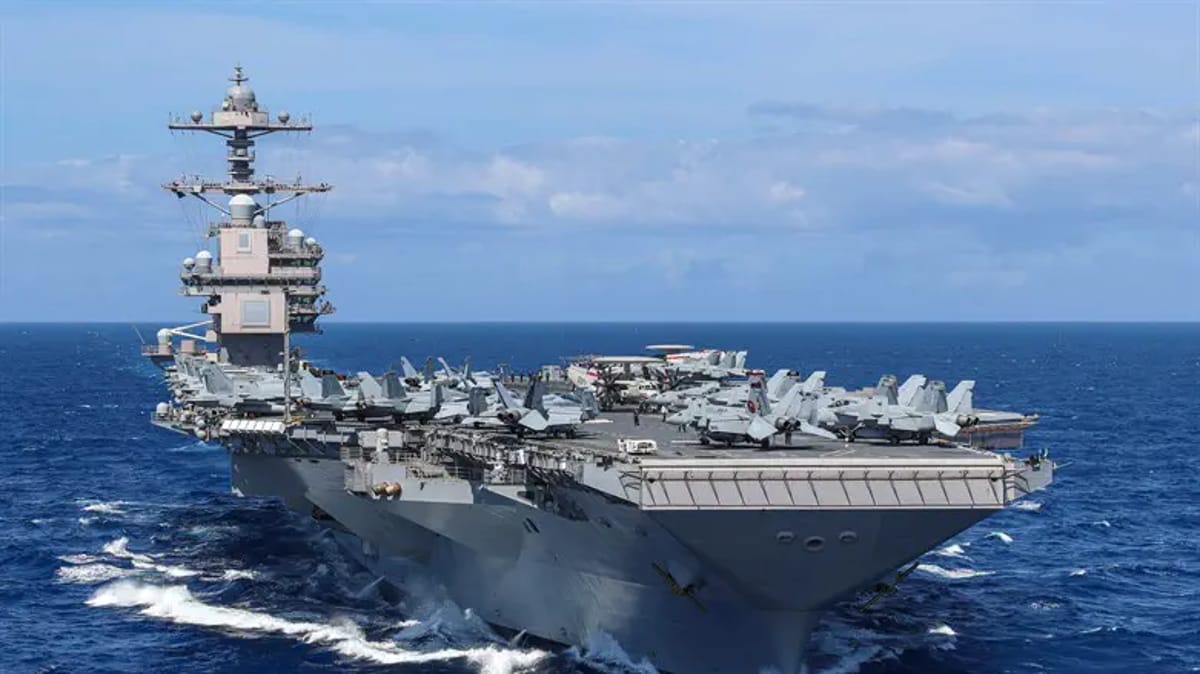
As the United States increases its naval presence in the Middle East to provide a deterrent against regional aggression, a sobering warning has emerged from former intelligence and military circles regarding the vulnerability of the fleet. John Kiriakou, a former CIA officer, recently raised alarms about the lethal capabilities of Iran’s hypersonic missile arsenal, suggesting that these high tech weapons could easily bypass existing American defenses. With city sized aircraft carriers currently patrolling the waters near the Persian Gulf, the potential for a catastrophic loss of life has become a central point of discussion among strategic analysts. Kiriakou points to a lack of countermeasures against missiles that travel at several times the speed of sound, a technology that Iran has rapidly mastered through a combination of foreign assistance and domestic engineering.
The Hypersonic Deficit
In a recent discussion regarding the military balance in the region, Kiriakou detailed a conversation he held with Colonel Doug McGregor, a veteran military strategist. Kiriakou sought to understand whether the massive supercarriers, which serve as the crown jewels of American power projection, could survive a targeted strike from Iran’s newest projectiles. "I was talking to Colonel Doug McGregor a few days ago about Iran's hypersonic missiles," Kiriakou explained. "I said, Doug, I'm not a military guy. I don't know the details of these programs. Can an aircraft carrier defend itself from a hypersonic missile?" The response he received was blunt and alarming.
According to Kiriakou, McGregor stated clearly that there is currently no defense from a hypersonic missile. This technical gap puts the thousands of American service members stationed on these vessels at extreme risk. Kiriakou emphasized the scale of the potential tragedy by noting that an aircraft carrier is effectively the size of a city, often carrying as many as 25,000 sailors. While the official crew complements of standard carriers are lower, Kiriakou’s assessment highlights the sheer concentration of personnel and assets that could be neutralized by a single successful hit from a weapon that travels too fast for conventional interception systems to track or destroy.
A Tri-National Technology Transfer
The source of this threat is a sophisticated domestic program that benefited significantly from global rivalries. Kiriakou noted that the Iranians have hypersonics because the Chinese and the Russians gave them the technology, which they then developed further domestically. This transfer of knowledge has allowed Tehran to field a weapon system that negates the traditional advantages held by the US Navy. While the US has invested billions in missile defense systems like the Aegis and Patriot batteries, these were largely designed to intercept ballistic missiles with predictable trajectories.
The maneuverability and extreme velocity of hypersonic missiles represent a different class of threat entirely. As the war between regional powers continues to simmer, the presence of these "carrier killers" in the Iranian arsenal forces a re-evaluation of American naval strategy. If the experts are correct and these city sized ships are truly defenseless against hypersonic technology, the deployment of carriers to the Middle East may represent more of a liability than a deterrent. For the 25,000 sailors Kiriakou referenced, the ocean has become a much more dangerous place as the technical superiority of the West faces its toughest challenge yet.