
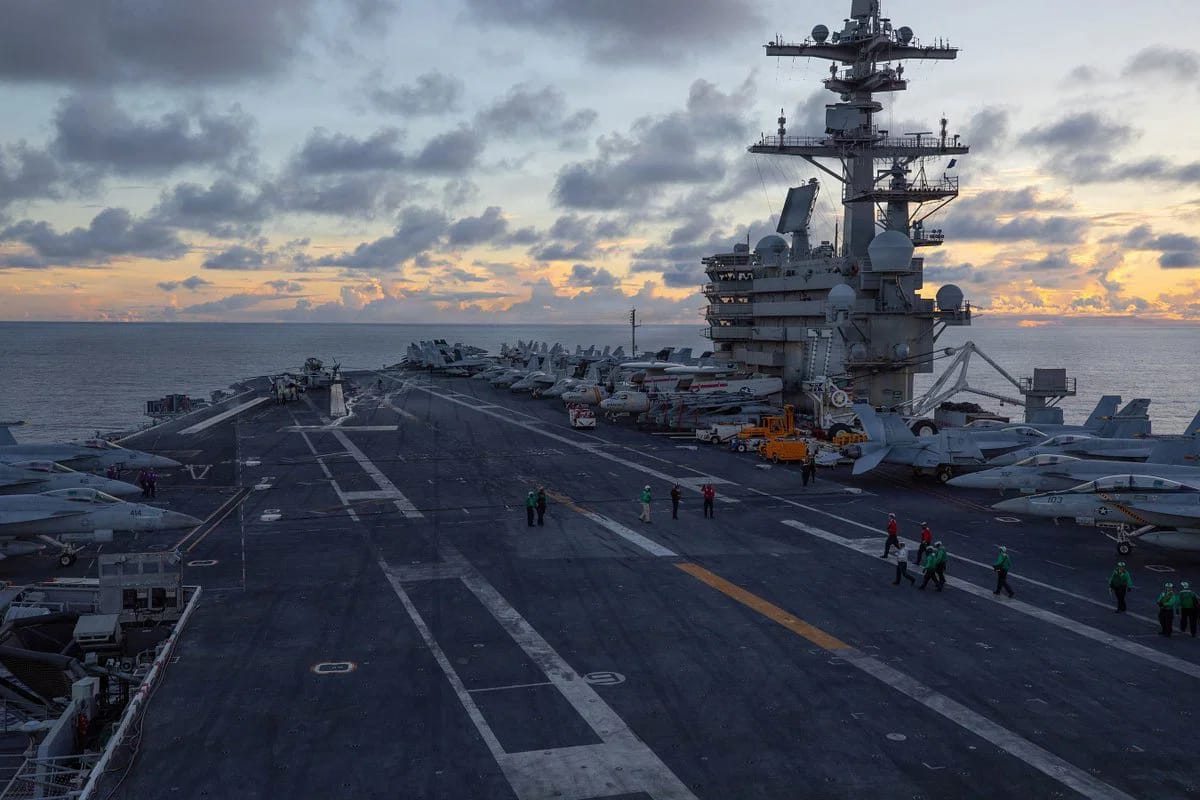
U.S. President Donald Trump issued a dramatic declaration on Monday, revealing that his administration is considering a renewed and expanded military offensiv, "Project Freedom," to forcibly break the Iranian naval blockade of the Strait of Hormuz.
The announcement, made during a Fox News interview, comes as global oil prices surge past $100 per barrel, causing severe economic strain across the West.
"Total Victory" and Failed Negotiations
President Trump expressed deep frustration with the deadlock in negotiations with Tehran. He revealed a key U.S. demand that has become a major sticking point: the U.S. insists on personally removing hazardous materials from Iranian nuclear facilities, arguing that Iran lacks the necessary technology to do so safely.
"The Iranians responded stupidly to the proposal," Trump told Fox News. "They thought I would get bored of the war or that pressure would make me retreat. But there will be total victory over them." The President added that he fears current ceasefire arrangements may be nearing an end.
European Fleet Sets Sail
While Washington deliberates, Europe has already mobilized. The French nuclear-powered aircraft carrier Charles de Gaulle is currently sailing toward the southern Red Sea.
- The Coalition: France is joined by Dutch and Italian warships.The Mission: Establishing a permanent naval force to guarantee freedom of navigation in the Strait of Hormuz.The Catalyst: Analysts say Paris and London moved once oil prices crossed the $100 mark, viewing the blockade as a direct threat to their national security.
Escalation in the Gulf: Firefights and Drone Strikes
The Persian Gulf has seen a spike in direct kinetic engagements over the last 48 hours:
- Naval Skirmish: On Friday night, Iranian Revolutionary Guard Corps (IRGC) forces attempted to strike three U.S. destroyers exiting the Gulf. U.S. forces returned fire in a significant exchange of heat.
- UAE Interception: The United Arab Emirates reported successfully intercepting two Iranian suicide drones launched toward its territory.
- Iranian Threats: The IRGC issued a "stern warning" stating that any strike against Iranian tankers or commercial vessels would result in a "violent attack" on U.S. regional centers and "enemy ships."
New Technology: The "Quantum Drone" Submarine Hunter
As the threat of Iranian naval mines, first deployed in early 2026, grows, a technological breakthrough has emerged. Danish company UMag Solutions unveiled the F1Mag system, which uses advanced quantum sensing.
- Capability: Mounted on drones, it can detect submarines at depths of 500 meters and naval mines at 30 meters without touching the water.
- Efficiency: It can scan 6,000 hectares per hour, providing a massive advantage in clearing blocked shipping lanes.
Tehran’s Response: Instructions from the Top
In Tehran, Ali Abdollahi, commander of the Khatam al-Anbiya headquarters, met with Supreme Leader Mojtaba Khamenei to present a readiness report of the armed forces. Khamenei reportedly issued "new instructions" for a "determined confrontation with enemies."
Despite the fiery rhetoric and exchanges of fire, some Israeli intelligence sources suggest that neither Washington nor Tehran is currently seeking a return to full-scale, all-out war, describing the current situation as a high-stakes "trial by fire."