
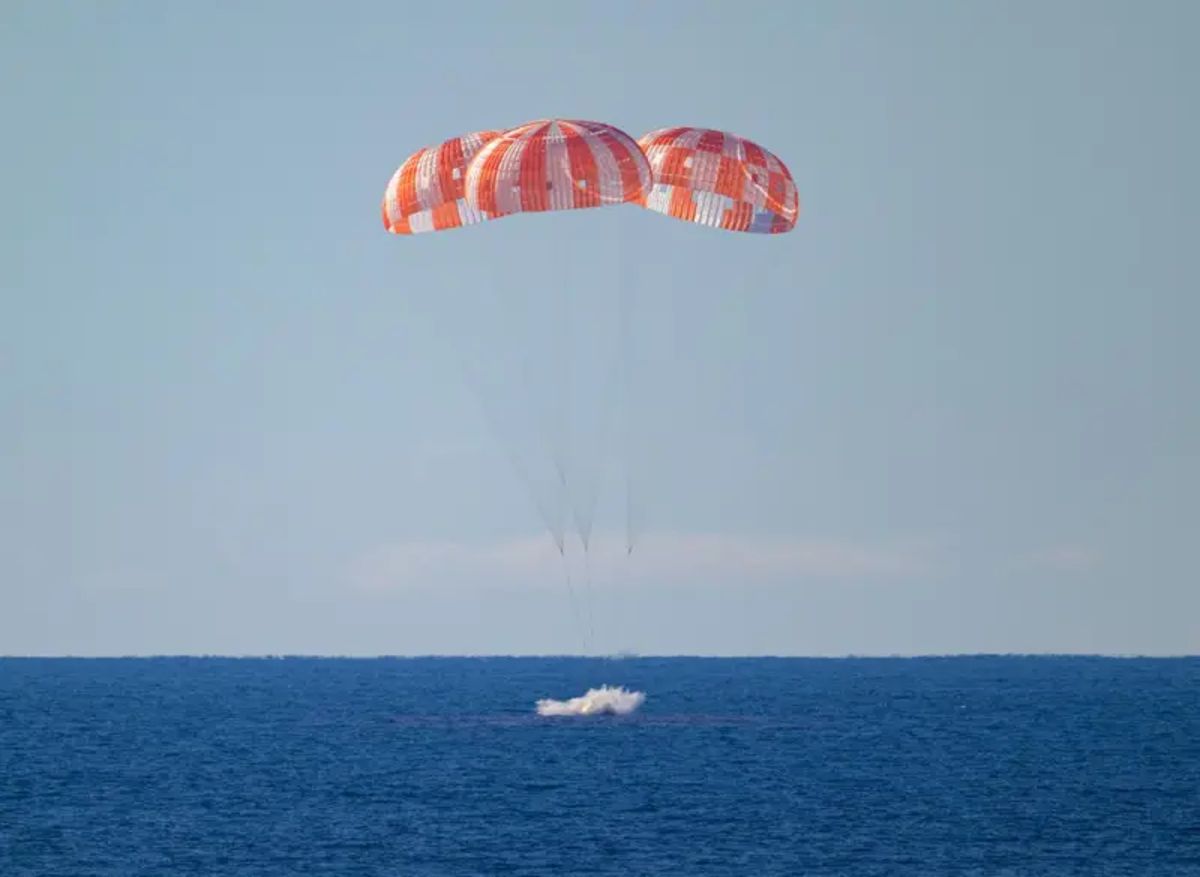
The Artemis II astronauts safely returned to Earth on Friday, splashing down in the Pacific Ocean off the coast of San Diego at 8:07 p.m. Eastern Time, marking the successful end of a 10-day mission around the Moon.
The return capped a landmark journey that took the four-person crew farther from Earth than any humans in history. NASA confirmed the splashdown proceeded as planned, with the Orion spacecraft reentering the atmosphere and completing a controlled descent before landing in the ocean.
Mission commander Reid Wiseman reported immediately after landing that all crew members were in good condition. “What a journey. We are stable. Four green crewmembers,” he said, indicating no major medical concerns.
Recovery teams quickly secured the capsule and transported the astronauts to a nearby recovery ship, where they began initial medical evaluations after more than a week in microgravity.
The crew includes three American astronauts, Wiseman, Victor Glover, and Christina Koch, along with Canadian Space Agency astronaut Jeremy Hansen. NASA officials said all four were “happy and healthy” following the splashdown.
The successful return prompted celebrations at NASA’s Mission Control Center in Houston, where engineers and staff applauded as the crew was safely recovered.
The mission is being described by NASA as a major milestone in its Artemis program, which aims to return humans to the Moon for the first time since 1972. Artemis II was the first crewed test flight of the program, designed to validate the Orion spacecraft and Space Launch System rocket under real mission conditions.
During the flight, the spacecraft reached a maximum distance of over 400,000 kilometers from Earth, surpassing previous human spaceflight records set during the Apollo era.
While Artemis II did not include a lunar landing, its successful completion is seen as a critical step toward future missions that will attempt to place astronauts on the Moon’s surface later this decade.
NASA officials said the splashdown demonstrated the reliability of the spacecraft’s heat shield, parachute systems, and recovery procedures, all key components for upcoming missions.
The astronauts underwent further medical checks and rehabilitation before returning to Houston, where they were reunited with their families and begin post-mission debriefings.