The Middle East teetered on the edge of a new round of devastating warfare on Tuesday as Iran signalled it was ready to unleash a sustained, high-intensity missile campaign, while US President Donald Trump revealed he had cancelled a planned American strike on Iran, scheduled for Tuesday, after urgent requests from three Gulf leaders to allow diplomacy more time.
According to a New York Times report published Tuesday morning, Iran's military is preparing for a short but ferocious confrontation, with plans to fire dozens to hundreds of missiles per day. Gulf energy infrastructure, refineries, oil terminals and ports, are among the anticipated targets. Iranian forces are also reportedly weighing the closure of the Bab el-Mandeb strait through their Houthi proxies, which would further choke global shipping already strained by the ongoing conflict.
"We were ready to go tomorrow in a very big way against Iran, but I decided to hold off."
US President Donald Trump, White House, May 18, 2026
Trump postpones the strike
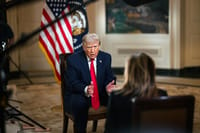
In a Truth Social post Monday, Trump announced that he had directed US military commanders not to proceed with the "scheduled attack of Iran tomorrow." The announcement came after the Qatari Emir, Saudi Crown Prince Mohammed bin Salman, and UAE President Mohammed bin Zayed all contacted Trump personally to ask him to hold off. Speaking to reporters at the White House, Trump said the three countries are conducting direct negotiations with Tehran on his behalf.
"There seems to be a very good chance of making a deal, if we can do it without bombing, I'll be happy," Trump said. He stressed, however, that the US military remains at full readiness, that Israel has been fully briefed, and that he would not permit Iran to acquire nuclear weapons under any circumstances. "We cannot allow Iran to have a nuclear weapon," he said.
Trump also hinted that his deadline is not open-ended, suggesting that if talks produce nothing within two to three days, military options remain firmly on the table. Senior US Senator Lindsey Graham, a close Trump ally, called for a "short but powerful strike" to reset the conflict to where it should be.
Iran's defiant response
Tehran reacted with open defiance. General Abd al-Rahim Mousavi Abdollahi, commander of Iran's elite Khatam al-Anbiya military unit, issued a stark warning to Washington and Jerusalem overnight: "Iran is ready and stronger than ever. Tehran will respond to any renewed attack with speed, resolve and overwhelming force." He added that any future retaliation will be more severe than what Iran unleashed during what it calls the "Ramadan War" imposed upon it.
Senior Iranian official Mohsen Rezaei mocked Trump publicly, saying: "He set a military deadline and then cancelled it himself — all based on vain hopes that the Iranian people and government would surrender."
Iran's state news agency TASNIM claimed that Trump, "having failed in the war against Iran," was now hoping to extract concessions through political and military pressure. Iran separately denied that any productive negotiations are taking place, calling US claims of ongoing talks "deceitful."
Background: A war already underway
The current escalation is the latest chapter in a war that began on February 28, 2026, when the US and Israel launched joint strikes on Iran under the codename Operation Epic Fury. The opening strikes killed Supreme Leader Ali Khamenei. Iran responded with mass missile and drone barrages across the region, hitting Israel, US military installations, and Gulf Arab states including the UAE, Saudi Arabia, Qatar and others. The conflict has killed thousands, displaced millions, and severely disrupted global shipping and energy markets.
Brent crude settled at $112.10 per barrel Monday, with oil prices surging amid fears of renewed fighting. Markets had briefly dipped on an Iranian media report suggesting the US had agreed to suspend crude sanctions during talks, a claim US officials did not confirm.
Netanyahu is expected to convene a restricted security cabinet Tuesday evening to discuss the latest developments. Israel has been kept fully informed of all US moves, Trump confirmed.