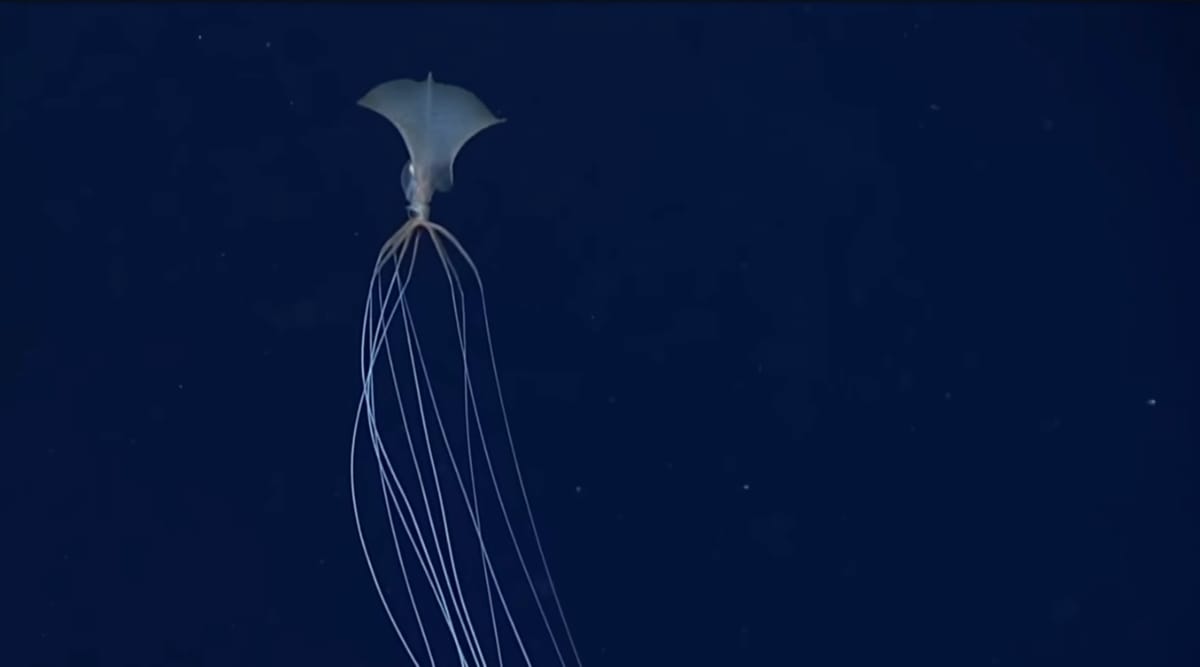
A remotely operated underwater vehicle exploring depths exceeding three kilometers off the California coast has provided researchers with an extraordinary encounter: footage of a bigfin squid, considered among the rarest and most mysterious creatures ever documented in the deep ocean.
The sighting occurred during an expedition conducted by the Monterey Bay Aquarium Research Institute (MBARI) in collaboration with researchers from NOAA, the U.S. National Oceanic and Atmospheric Administration. The team was operating the remotely operated vehicle Doc Ricketts near Davidson Seamount, an underwater mountain located approximately 130 kilometers southwest of Monterey. At a depth of roughly 3,277 meters, the robot's cameras detected a creature hovering just above the seafloor.
Scientists monitoring the live feed initially struggled to identify what they were seeing. Olivia Soares Pereira, a researcher at MBARI, recalled first noticing what appeared to be tentacles at the edge of the screen and initially thought she might be looking at a jellyfish. However, once she recognized the distinctive structure of squid arms, she immediately identified it as a Magnapinna specimen.
The observed squid measured an estimated 1.25 meters from the top of its body to the tips of its appendages. It propelled itself using two large fins while eight arms and two elongated tentacles trailed behind. Magnapinna squid possess an especially unusual appearance, characterized by extremely long, thin arms that form distinctive "elbow" joints and dangle downward for considerable distances.
The discovery holds particular significance because only approximately 70 individuals of this type have been documented or collected worldwide to date. This marks the first confirmed documentation of a living bigfin squid in the northeastern Pacific Ocean, and also represents the first such observation within the Monterey Bay National Marine Sanctuary.
Despite their striking appearance, scientists know remarkably little about these animals. Even their diet remains uncertain, and fundamental questions about their hunting methods, reproduction, and behavior remain unanswered. According to MBARI, adult specimens typically inhabit depths ranging from approximately 1,600 to 6,200 meters.
The rare encounter was not the expedition's primary objective. Researchers had embarked on a ten-day voyage to study ecosystems surrounding underwater mountains, including an investigation into whether mysterious grooves found on the seafloor were created by beaked whales foraging for food. Instead, they received a rare glimpse of one of the deep ocean's most elusive inhabitants.
This was only the second time MBARI researchers have encountered a squid of this genus. Their previous sighting occurred near Hawaii in 2001, meaning approximately 25 years passed before the mysterious creature appeared again before the institute's cameras.