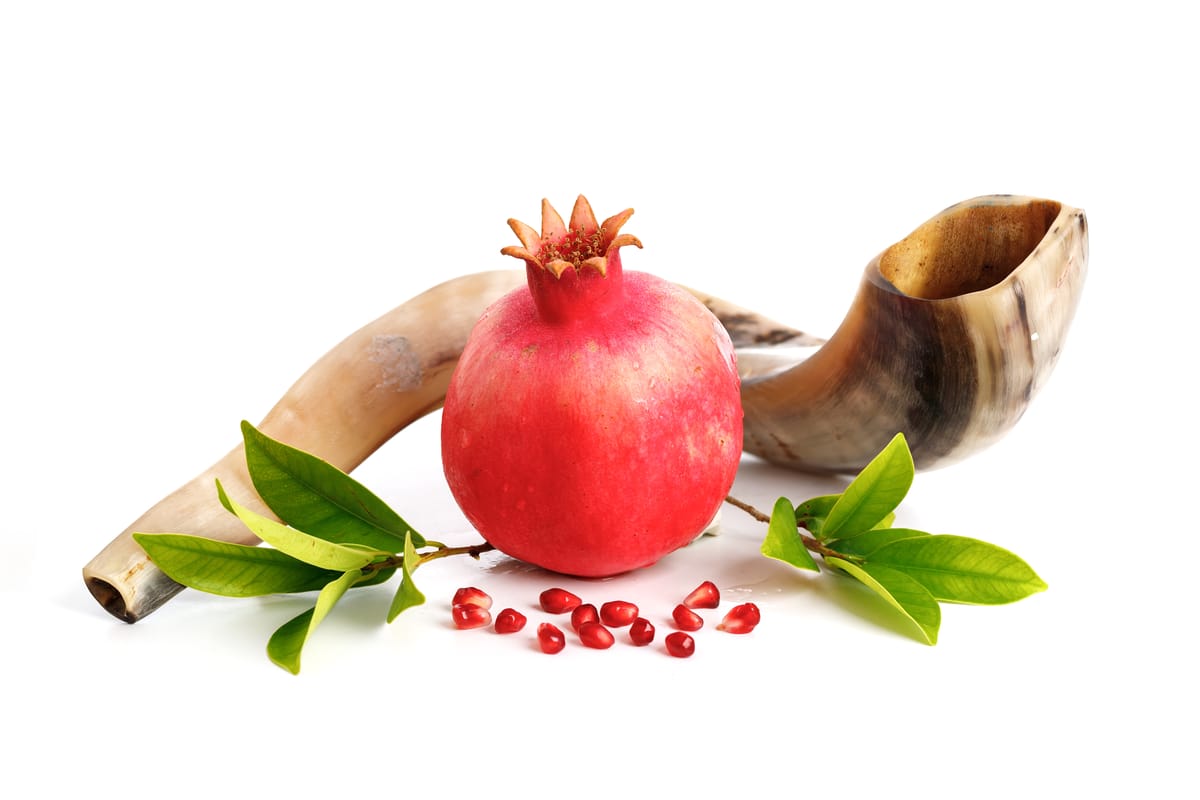
Rosh Hashanah 5787 begins at sundown on Friday, September 11, and runs through nightfall on Sunday, September 13. The first day falls on Shabbat this year, which quietly rearranges several of the holiday's best known practices, including one that a lot of people will notice only when they show up at the water on the wrong afternoon.
Most of what happens over those two days is not written in the Torah. It comes from custom, some of it Talmudic, much of it medieval, and a fair amount of it argued over for centuries by people who took the details seriously. Here is where some of the more curious ones came from.
Why Many People Do Not Eat Nuts
The custom is recorded by Rabbi Moshe Isserles, the Rema, in his gloss to the Shulchan Aruch, Orach Chaim 583:2, drawing on the Maharil. He gives two reasons, and they pull in different directions.
The first is numerical. The Hebrew word for nut, egoz, has a gematria of 17, which the Rema equates with chet, sin. The arithmetic does not quite work on its face, since chet spelled fully comes to 18. The standard resolution is that the silent alef is not counted because it is not pronounced. Later authorities noticed a second problem, which is that 17 is also the value of tov, good. The Chida raised exactly that objection and answered it in kabbalistic terms, that a word can hold both a positive and a negative charge, and on a day of judgment the negative one is the one to avoid.
The second reason is entirely practical. Nuts increase saliva and phlegm, which interferes with prayer. The Darkei Moshe records that the Maharil avoided nuts specifically so that he would not have to clear his throat or spit during the shofar blasts, which are the central obligation of the day and easy to miss a fraction of.
Which reason you follow determines what actually stays off the table. Egoz means walnut, so on the gematria reasoning the custom covers walnuts alone. The Magen Avraham points out that on the phlegm reasoning it should cover every nut. The Mateh Efrayim extends it further, to beans and peanuts. Rabbi Schneur Zalman of Liadi adds hazelnuts. The Be'er Moshe rules that ground nuts baked into a cake or a sauce are not a problem, since the quantity is too small to matter, though many people are stringent anyway when walnuts are involved.
This is primarily an Ashkenazi minhag, and that some authorities never adopted it at all. Rabbi Nosson Adler and the Chatam Sofer were not particular about it. Separately, the Vilna Gaon is recorded in Ma'aseh Rav as not eating grapes on Rosh Hashanah, a restriction almost nobody else kept.
Why Many People Do Not Sleep During the Day
The same paragraph of the Rema records a custom not to sleep during the day on Rosh Hashanah, and cites a line from the Jerusalem Talmud: one who sleeps at the start of the year, his mazal sleeps.
There is a complication. Nobody has been able to find the line. The Aruch HaShulchan says so bluntly, noting that the source in the Yerushalmi is simply not known to us. It is quoted, repeated and codified, but the original text does not appear in our editions. That has not weakened the custom, which is widely kept, but it has shaped how the later authorities handled it.
The general understanding is that the concern is not sleep as such but dormancy. Rabbi Eliyahu Kitov's formulation is the one most people know: the day should be spent in Torah study or in saying Tehillim, and one who sits around idle is treated as though he slept anyway. On that reading, scrolling on the couch is no better than the nap.
The scope is disputed. Many hold the custom applies until midday, and that after chatzot a nap is permitted. The Arizal was not concerned about it and held that once the shofar has been blown and midday has passed, the judgment has already been settled. In the other direction, the Sanzer Rav is reported to have kept the statement at face value and avoided sleep on Rosh Hashanah entirely, including at night, and the Kaf HaChaim records a practice of waking before dawn. Poskim have also long noted that someone too exhausted to daven or learn properly is better off sleeping, since the point of the custom is alertness, not endurance.
This year the custom collides with Shabbat, when an afternoon nap is itself a form of oneg Shabbat. Practice varies, and it is the kind of question worth putting to your own rabbi rather than resolving from an article.
The Foods That Are Puns
The simanim, the symbolic foods, are older than the nut custom by a long way. In the Talmud, Abaye says that since omens carry meaning, a person should make a point of eating gourd, fenugreek, leek, beets and dates at the start of the year. Each one is a play on words in Aramaic or Hebrew: karti and yikartu, that our enemies be cut off, silka and yistalku, that they be removed, tamar and yitamu, that they be finished.
Apples and honey are not on Abaye's list. They enter later, through medieval Ashkenazi sources, and then became the image that represents the entire holiday. Sephardi and Middle Eastern communities generally kept the fuller version, a seder of simanim with a short yehi ratzon recited over each one, which is why fish heads sell out in Israeli markets in the days before the holiday. The fish head, or a ram's head in some homes, carries the request to be a head and not a tail. Some use a ram's head as a reference to the Akedah, read from the Torah on the second day.
The negative side of the same logic explains the foods people avoid. Vinegar, lemon, and sharp or bitter dishes are kept off many tables for the two days, on the reasoning that a sour year is not what anyone is asking for.
Tashlich, and What Changes This Year
Tashlich is normally said on the afternoon of the first day, at a body of water, ideally one with fish. The text comes from the closing verses of Micah, which speak of sins being cast into the depths of the sea.
Because the first day is Shabbat this year, most Ashkenazi communities will push Tashlich to Sunday afternoon. The Mishnah Berurah explains the deferral as a concern about carrying machzorim. Not everyone accepts it. The Mateh Efraim held that Tashlich should be said on Shabbat as usual, and the Ben Ish Chai ruled the same way, which is why a number of Sephardi communities will be at the water on Saturday. Jerusalem practice has long favored keeping it on the first day regardless. Anyone who misses it entirely has until Hoshana Rabbah at the end of Sukkot.
The Shabbat overlap changes other things too. The shofar is not blown on Shabbat, so the only sounding this year falls on Sunday, September 13. Avinu Malkeinu is omitted on Shabbat in Ashkenazi practice. And in a detail that catches people every year, the shofar is deliberately not blown on erev Rosh Hashanah, breaking the month-long run of Elul blasts so that the obligatory sounding is clearly separated from the voluntary ones. The kabbalistic explanation is that the silence confuses the Satan.
One more absence: Hallel is not said on Rosh Hashanah. The Talmud in Rosh Hashanah 32b gives the reason as a question the angels ask, and God answers. Can it be that the King sits on the throne of judgment, with the books of life and death open before Him, and Israel sings praise songs.
There is a coda to the nut custom that is easy to miss. In some communities, children were given nuts to play with on Yom Kippur, exactly ten days after the adults refused to eat them. The explanation offered is that Yom Kippur is the day sins are converted into merits, and so egoz stops meaning chet and goes back to meaning tov.
Shana tova.