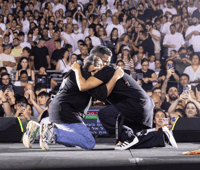
The creative director of Israel’s Eurovision delegation, Yoav Tzafir, has provided a sobering look at the intense hostility and potential danger that surrounded the team during the grand final in Vienna. While celebrating Noam Bettan’s impressive second-place finish with the hit song "Michelle," Tzafir admitted that the atmosphere inside the arena turned profoundly dark as Israel temporarily led the voting charts. He confessed that the level of vocal aggression from the audience was unprecedented, causing real concern for the physical safety of the crew.
"The booing was violent, there was violence in it," Tzafir stated during an interview on Sunday, reflecting on the moments when Israel appeared on the verge of capturing the top spot. He noted that while his heart desperately wanted a victory, his logic told him that a second-place finish was a safer outcome for the team under the current international climate. Tzafir added that he did not believe it was an exaggeration to say that the situation could have degenerated into physical altercations had the trophy been handed to Israel.
The director described the vocal opposition as a new form of international hostility that moved beyond traditional political protest. In previous rounds, the criticism had remained relatively contained, with polite applause masking the underlying tension, but as Israel neared a historic win, the restraint disappeared. Despite the exhausting and stressful environment, the delegation returned home proud of Bettan’s performance, framing the silver medal as an absolute triumph given the severe geopolitical headwinds.
Tzafir also shared a series of personal premonitions and historical coincidences that led him to anticipate the second-place result. He pointed to a pattern from 1982 and 1983, where an initial victory was followed by a consecutive second-place finish, a sequence that mirrored the transition from Yuval Raphael’s 2025 win to Bettan’s current run. During the tense final moments of the calculation, as the voting numbers fluctuated wildly between Australia, Bulgaria, and Israel, the team remained in a state of sensory overload until the final points were finalized.
Upon his return, Noam Bettan issued an emotional statement to the public, using his newly elevated platform to call for domestic unity and mutual respect. "We are in a moment of unity and it’s amazing and fun," the young artist remarked, "but there is also tomorrow, and there is another year, and another 100 years. I ask us to try to make an effort and be good to one another." Tzafir praised the singer’s maturity and professionalism, noting that Bettan’s career is set to expand significantly following his exceptional performance under pressure.
The producers emphasized that Bettan’s journey serves as an inspiring message for young artists across the country, recalling that the singer had been rejected during his initial audition for a prominent reality show a decade ago. His success in Vienna proves that resilience and dedication can overcome early failures, even on the world's most scrutinized stage. As the cultural fallout of the event settles, the delegation’s experience remains a stark reminder of the complex and often hostile environment that Israeli public figures must navigate abroad during times of war.