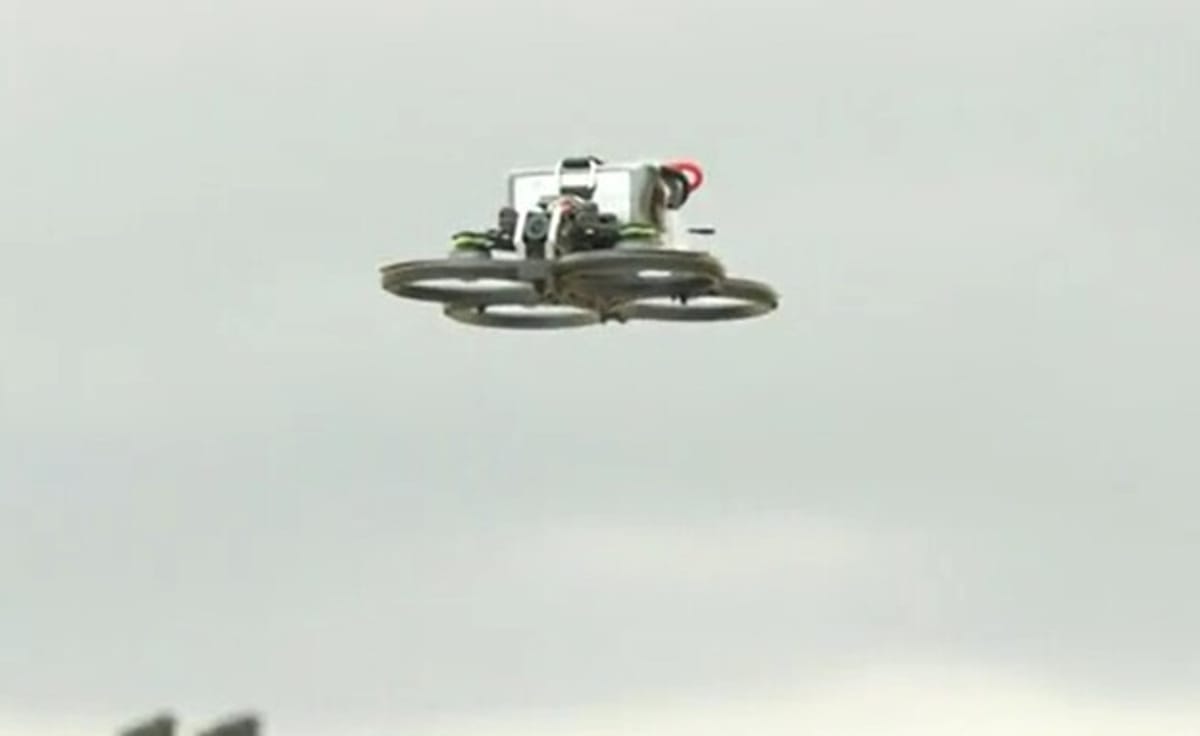
While the IDF continues to deploy massive amounts of wire netting to protect its ground forces from standard remote-controlled attacks, a far more dangerous aerial threat is developing over the horizon. Security experts have confirmed the emergence of cellular-powered drones that operate utilizing standard physical or electronic SIM cards. This technology allows a pilot sitting in an operations room in Tehran to guide a weapon through the skies of Tel Aviv in real time, bypassing traditional military frequencies entirely.
The primary danger of these weapons rests on their simplicity and low cost of manufacturing. The necessary components, including cellular modems and GPS chips, can be easily purchased through commercial websites like AliExpress. Terror groups can assemble these lightweight devices inside Israeli territory, insert a local SIM card, attach a small payload of commercial explosives, and hand total flight control to operators stationed thousands of miles away, completely eliminating the need to cross an international border fence.
Furthermore, these cellular systems present an immense challenge for traditional military tracking networks. Because the drone utilizes standard commercial networks to transmit data, military radar arrays often identify the flying object as a standard mobile device rather than an incoming weapon. This makes it incredibly difficult for electronic warfare units to differentiate between a lethal suicide drone traveling over a highway and an ordinary civilian driving a vehicle on the ground below.
The implementation of this technology follows the highly successful Ukrainian operation known as "Project Spiderweb." During that campaign, Ukrainian forces managed to damage or destroy over 40 Russian fighter jets on their own runways by launching small cellular drones from deep within Russian territory, controlling them remotely via the domestic Russian mobile network. Security experts warn that Iranian engineers have thoroughly studied these tactics and are now transferring the manufacturing knowledge to their regional proxy networks.
The revelation has exposed an uncomfortable gap in Israel's long-term defense planning. While Iranian drones have been active on global battlefields since 2022, the IDF only completed its official anti-drone combat doctrine eighteen months ago. It was only two weeks ago that an Air Force Brigadier General was formally appointed to centralize the military’s response to the threat. Former air defense commanders warn that the technology is evolving like water, constantly finding new paths around existing blocks.
Faced with this reality, the military is rushing to conduct emergency testing on alternative detection methods, including acoustic sensors and localized cellular jamming fields. However, private defense contractors warn that the response time must increase exponentially to match the speed of commercial technological developments. Until a permanent electronic solution is fielded, troops on the frontline will remain reliant on physical netting to catch an enemy that can see them from across the world.