
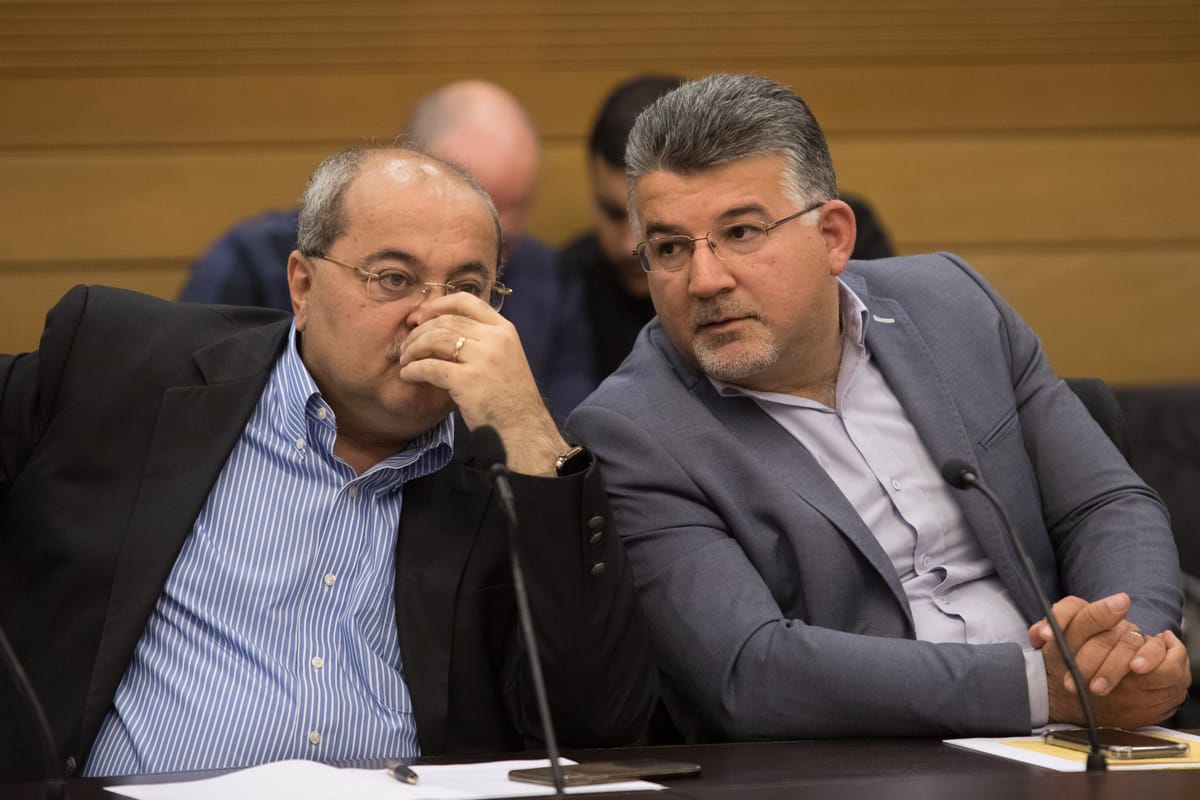
Former MK Yousef Jabareen was elected leader of the Arab-majority Hadash party on Saturday, winning 82% of the vote in internal primaries and becoming the faction’s first new chairman in more than a decade.
Jabareen, a legal scholar and longtime Hadash activist from Umm al-Fahm, will replace Ayman Odeh, who has led the party since 2015. Odeh did not seek reelection and is expected to leave the Knesset at the end of the current term.
Jabareen served in the Knesset from 2015 to 2021. After his victory, he focused his remarks on the need to reunite the Arab parties under the Joint List framework, saying the move was demanded by the political moment and by Arab voters.
“I call on all members of the Joint List to rally and move forward in negotiations, and become an influential and decisive political force,” Jabareen said.
Hadash has been pushing to reestablish the Joint List, which was first formed in 2015 and reached its peak in 2020 with 15 Knesset seats. The party argues that a united Arab slate is necessary to maximize Arab political power, particularly ahead of an election in which turnout and bloc arithmetic may be decisive.
In January, Hadash, Ra’am, Ta’al and Balad signed an agreement committing to work toward a joint run. But negotiations have made little visible progress. Pressure has grown from Arab voters and local activists, especially as Arab communities demand more government action and resources to confront the severe wave of violent crime.
Hadash has described the upcoming election as critical and has pledged to help bring down the current government. Jabareen said he would work to prevent Prime Minister Benjamin Netanyahu, National Security Minister Itamar Ben Gvir and Finance Minister Bezalel Smotrich from winning another term, while fighting for equality, democracy and peace together with Jewish democratic forces.
Saturday’s vote also shaped Hadash’s Knesset slate. Human rights activist Jafar Farah was elected to the second slot, MK Ofer Cassif was reelected to the third, traditionally reserved for a Jewish candidate, and former MK Youssef Atauna won the fourth slot.
Nihaya Wishahy was elected fifth, making her the only woman in the top five. For a party that has long emphasized women’s representation, the absence of a woman in the top four is not exactly a campaign poster anyone asked for, but here we are, democracy doing its little internal contradictions routine.
Jabareen’s victory also marks a geographic shift for Hadash. The party has traditionally been dominated by figures from northern and coastal cities, while Jabareen comes from the Triangle region, an area heavily affected by violent crime and home to roughly 250,000 Arab citizens. His election is expected to boost Hadash’s engagement there, while Atauna’s return may help the party compete with Ra’am for Bedouin voters in the Negev.