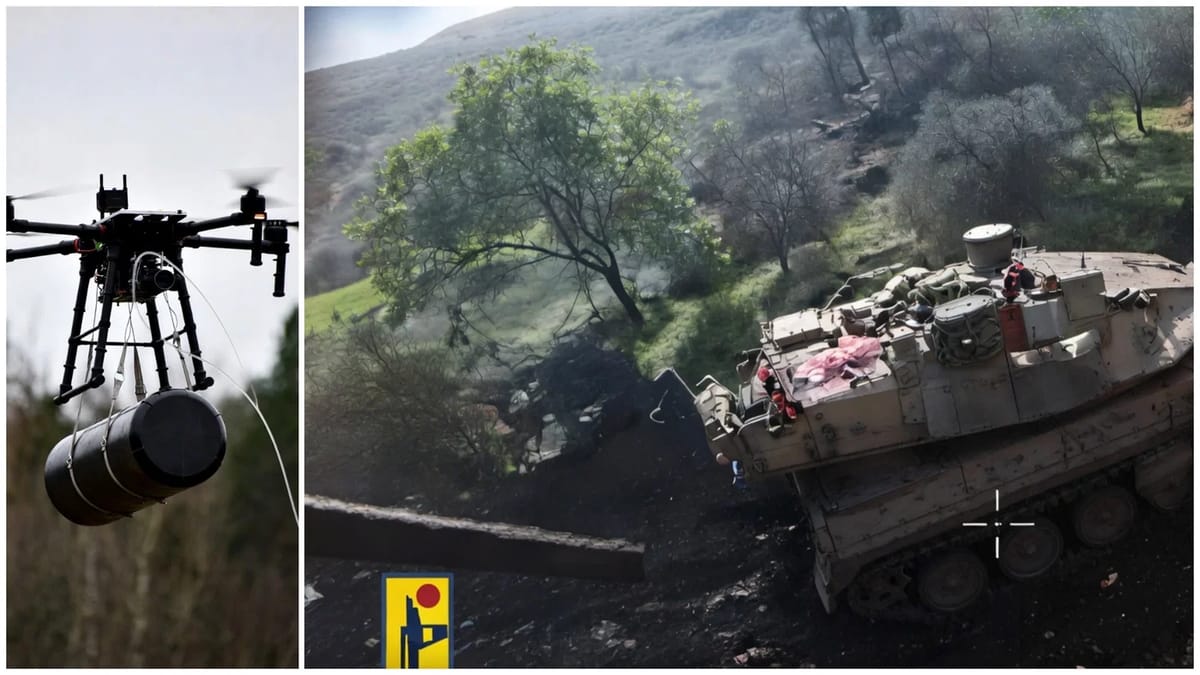
As Operation "Lion’s Roar," launched in March 2026 following the assassination of Ali Khamenei, intensifies, IDF armored forces are pushing past the Litani River. However, the price paid in steel is climbing.
At the heart of the threat are Hezbollah's FPV (First-Person View) drones, which have undergone a lethal upgrade inspired by the fighting in Ukraine. Hezbollah is flooding social networks with footage from the drone's "point of view" as it dives toward Merkava Mark 4 tanks, D9 bulldozers, and Namer APCs (Armored Personnel Carriers).
The Innovation: The "Unstoppable" Fiber Optic Drone
The most alarming development is Hezbollah’s use of fiber-optic cables. Unlike standard drones that rely on radio frequencies, these drones unspool a thin glass thread as they fly, transmitting data directly through the wire.
- The Tactical Nightmare: Because the drone does not emit radio signals, it cannot be detected or jammed.
- The Failure of EW: Israel’s sophisticated Electronic Warfare (EW) systems, designed to "silence" radio-controlled threats, are rendered useless against the total "silence" of the fiber-optic cable.
The Israeli Defense: Technology vs. Physical Shields
The IDF is attempting to counter this invisible threat through a combination of active systems and passive physical barriers:
1. Upgraded "Trophy" (Meil Ruach) System
The Trophy system, originally designed to intercept high-speed anti-tank missiles, has been recalibrated to target small, slow-moving aerial threats. However, the lack of electromagnetic signature from fiber-optic drones makes early detection significantly more difficult.
2. "Cope Cages" (Protection Grids)
Metal mesh screens have been installed over tank turrets. These "cages" are designed to detonate a drone’s explosive payload before it makes direct contact with the tank’s primary armor.
3. The Merkava’s Structural Advantage
The Merkava Mark 4 possesses a unique design advantage: its engine is located in the front.
- Crew Safety: In a frontal strike, the engine acts as an additional shield for the crew sitting in the back.
- Turret Coverage: The Mark 4’s wide turret design covers sensitive body parts, making it harder for drones to hit vulnerable ventilation points.
The Vulnerability Remains
Despite heavy plating, weak points persist. Skilled Hezbollah operators target the thinner armor on top of the turret, open hatches, or sensitive connection points.
While Israel is currently racing to procure thousands of its own drones to strike back, the battlefields of Lebanon are proving that a single, thin glass wire can threaten the most protected technological wonders on earth.