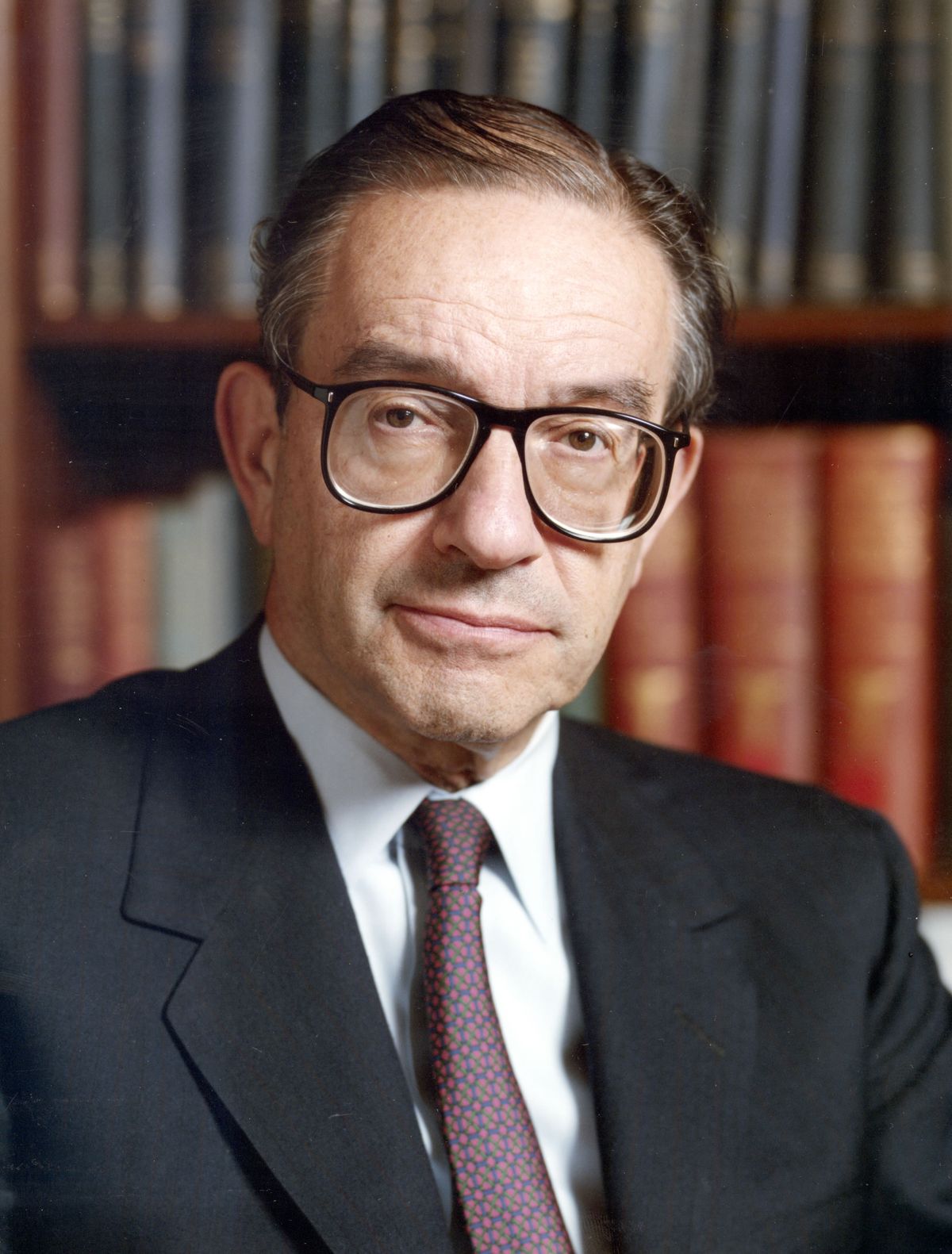
Alan Greenspan, the Jewish economist from Washington Heights who rose to become the most powerful central banker in modern history, died Monday morning at his home from complications of Parkinson's disease. He was 100 years old.
His wife of 29 years, NBC News chief Washington correspondent Andrea Mitchell, confirmed the news in a statement. "He will be remembered for his brilliance and his kindness. Being his life partner was the joy of my life," she wrote.
Greenspan was born to Jewish parents on March 6, 1926, in New York's Washington Heights. His father was a stockbroker and financial analyst. He briefly attended the Juilliard School as a young man, playing clarinet and saxophone, before turning his prodigious intellect toward economics. Few who watched the teenager play jazz in Depression-era New York could have predicted that he would one day move global markets with a carefully chosen phrase.
Greenspan served five terms as Fed chairman under four presidents, starting with Ronald Reagan, who nominated him in 1987. His tenure of over eighteen years is the second longest in the history of the institution. During that span he became known as the "Maestro," a nickname that captured both his technical command of monetary policy and his near-mystical status in financial markets.
Two months into Greenspan's tenure, the stock market suffered its largest one-day percentage decline, when the Dow plunged 22% on October 19, 1987, a day that became known as "Black Monday." The next day, Greenspan announced that the Fed stood ready to support the economic and financial systems, and his assurance helped the market begin a relatively quick recovery.
The decades that followed cemented his reputation. During his time at the Fed, the U.S. economy experienced one of the strongest peacetime expansions in its history. Unemployment fell below 4%, the stock market reached then-record highs, and the federal government began running budget surpluses rather than deficits.
His legacy is complicated by what came after. Greenspan dismissed talk of a housing bubble while he was in office, saying that while individual local markets might be overpriced, there was no evidence of a nationwide problem. When home values collapsed nationwide and foreclosures and bank failures soared in 2008, he testified before the House Oversight Committee that he was in a "state of shocked disbelief." Critics argued that years of low interest rates under his stewardship had inflated the very bubble he failed to see.
Greenspan remained engaged in public life well into his final years. In January 2026, just months before his death, he signed a joint statement with other former Fed and Treasury officials denouncing a criminal probe into current Fed Chair Jerome Powell, calling it "an unprecedented attempt to use prosecutorial attacks to undermine" the Fed's independence.
In 1997, Greenspan married NBC journalist Andrea Mitchell in a ceremony officiated by the late Supreme Court Justice Ruth Bader Ginsburg. The union of two of Washington's most prominent Jewish public figures became something of an institution in the capital.
He is survived by his wife Andrea Mitchell.