American concern over a return to full-scale war with Iran is rising after a week in which Iranian forces repeatedly fired on US warships in the Middle East, Israel's Channel 12 reported Thursday. Officials in Washington assess these are the most serious Iranian attempts yet to pull the region back into broad conflict.
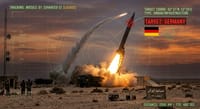
Missiles were launched at American vessels at least three times over the past week, including at an aircraft carrier. Iran also fired a large salvo at US forces in Jordan, where authorities said 18 of 20 ballistic missiles were intercepted. CBS News reported that several American aircraft were damaged in that attack.
What has changed is the accuracy. According to the Wall Street Journal, the recent launches came closer to striking than previous attempts, in part because Iran used warheads capable of maneuvering in flight. US Central Command said the ships evaded, but American officials believe Iran has improved its ability to locate and strike moving vessels, possibly with Russian or Chinese assistance.
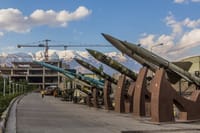
Two Iranian missiles are at the center of that assessment. The Qassem Basir, unveiled in May 2025 as an upgrade of the Haj Qassem, is a two-stage solid-fuel missile with a range of roughly 1,200 kilometers and a warhead of about 500 kilograms. It is credited with electro-optical or infrared guidance, a maneuvering reentry vehicle and countermeasures against electronic warfare. Its ability to hit moving ships has not been publicly demonstrated. The Khalij Fars is a dedicated anti-ship ballistic missile revealed in 2011 and in service since 2014, built on the Fateh-110 family, with a range of about 300 kilometers, a warhead of roughly 650 kilograms and electro-optical terminal guidance on top of inertial navigation. Iranian claims about its speed and reaction time have not been verified in the West.
Both carry electro-optical seekers that let them identify a target and correct course in the final phase of flight, which matters against ships because ships move.
The American worry is not only the missile but the eyes behind it. A terminal seeker still needs to be pointed at roughly the right patch of ocean, and US officials say recent American strikes should have badly degraded Iran's long-range radar, observation and identification capabilities. That gap is why suspicion has fallen on Moscow and Beijing. In May, Washington sanctioned China-based entities it accused of supplying Iran with satellite imagery during the war.
Reuters reported Thursday that Iran received millions of dollars worth of Chinese air defense systems over the past year, delivered through a barter arrangement in which Iran supplied oil to China and received credit toward Chinese goods rather than cash, allowing both sides to work around sanctions. Iran also acquired medicines, vehicles and communications equipment through the same channel.
The escalation is unfolding against severe economic pressure. Nineteen American ships are enforcing a blockade that has cut Iranian oil exports, and according to tracking firm Kpler no Iranian crude has passed it since it was reimposed in mid-July. Inflation is running above 80 percent on an annualized basis, and the International Monetary Fund projects the Iranian economy will contract by 5.4 percent this year. The rial has fallen sharply and fuel subsidies are being cut. Saudi Arabia and the United Arab Emirates are routing more oil through pipelines that bypass Hormuz, while the United States escorts convoys through the strait.
For Tehran, the ability to threaten traffic through Hormuz and the American forces protecting it is both a military tool and a bargaining chip. The Revolutionary Guards have signaled they want to escalate in order to force the blockade's removal. Iran has declared it will impose an exclusion zone for shipping in the strait and the Persian Gulf, and the UK Maritime Trade Operations center reported Wednesday that several merchant vessels had been hit in the Persian Gulf and the Gulf of Oman.
Channel 12 notes an additional calculation. With US midterm elections less than two months away, Iran has an interest in inflicting as much damage as possible on Washington and on President Trump before the vote.
Diplomatic pressure sharpened this week as well. The International Atomic Energy Agency's Board of Governors voted Wednesday, in a move led by the United States, France, Germany and Britain, to refer Iran to the UN Security Council over its failure to cooperate with inspectors and meet its obligations under the Non-Proliferation Treaty. It is the first such referral in 20 years. Twenty-three of 35 member states voted in favor. China, Russia and Niger opposed, eight abstained and one did not vote.
Niger's position drew particular attention. The country is run by a military junta with close ties to Moscow and holds substantial uranium deposits, and Iran has previously been reported to be expanding its relationship there in pursuit of access to them.
The referral opens the door to further sanctions and asset freezes, though such measures are unlikely to advance given expected Russian and Chinese vetoes at the Security Council.
Tehran rejected the decision angrily. Iran's ambassador to international organizations in Vienna, Reza Najafi, called it a political instrument and said it damages the agency's independence, impartiality and credibility. He argued that the war with the United States and Israel makes compliance with monitoring obligations impossible. Deputy Foreign Minister Kazem Gharibabadi said the United States and Israel attacked safeguarded nuclear facilities, disrupted the verification process, and then used that disruption as grounds for the referral.
Iran has barred inspectors from damaged sites since the American and Israeli strikes of June 2025, and the agency has been unable to verify the status of Iran's stockpile of uranium enriched to 60 percent, close to weapons grade. A comparable board resolution passed on the eve of Operation Rising Lion in June 2025.