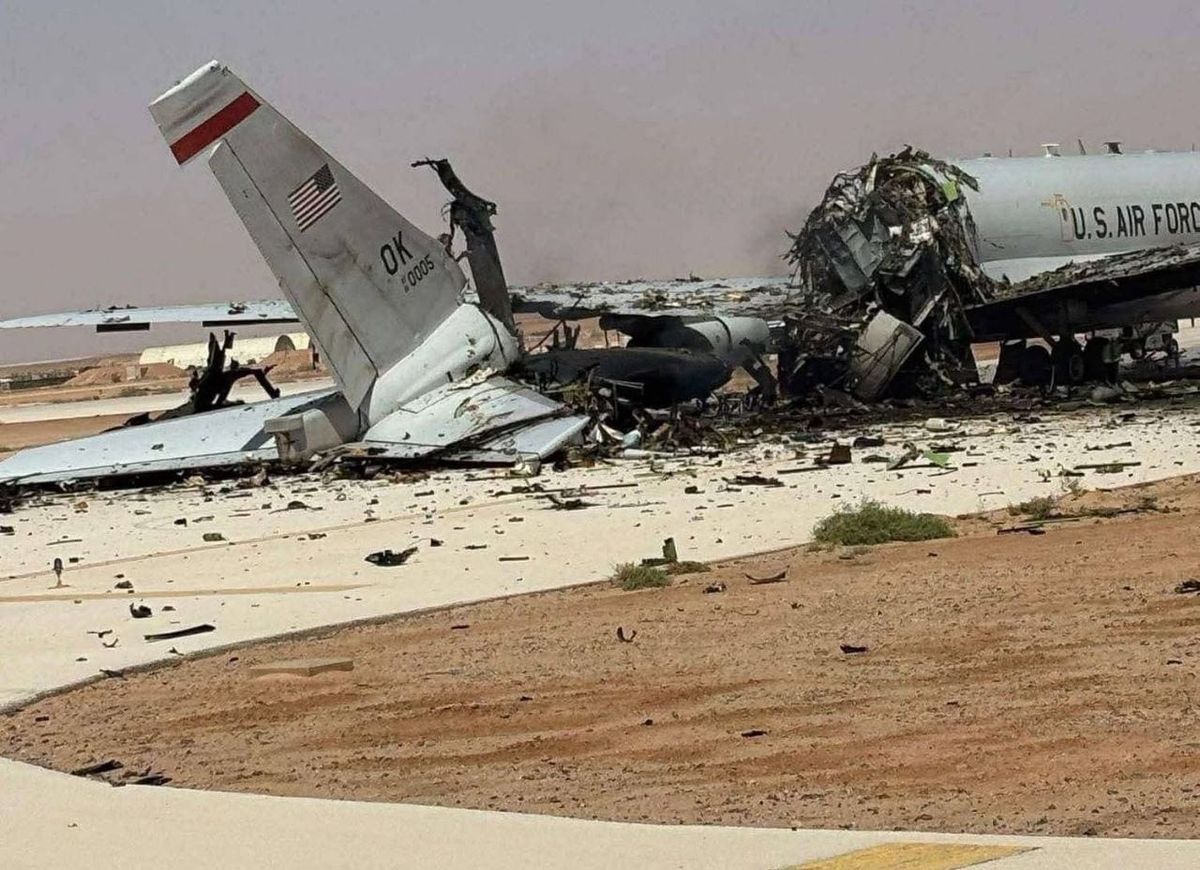
An Iranian ballistic missile and drone attack on this key U.S. forward operating base wounded at least 10 American service members and struck multiple high-value aircraft, including a critical E-3G Sentry airborne early-warning plane, U.S. and Arab officials said.
In addition to a number of KC-135 Stratotankers that suffered various levels of damage in yesterday’s Iranian ballistic missile and drone attack on Prince Sultan Air Base in Saudi Arabia, a U.S. Air Force E-3G “Sentry” Airborne Early Warning and Control (AEW&C) Aircraft also suffered significant damage in the attack, according to officials who spoke to Air & Space Forces Magazine.
The U.S. Air Force operates 16 E-3Gs, with around 40-50% of aircraft currently deployed to the Middle East for Operation Epic Fury. Production lines for the E-3 were ceased in the 1990s, while the first airframe was retired in 2023 in preparation for the E-3 to be replaced by the E-7 Wedgetail in 2027, however, in June 2025 the Pentagon announced the cancelation of the E-7 in favour of space-based solutions, including the proposed Golden Dome, and the E-2D Advanced Hawkeye.
The strike on Friday involved at least one ballistic missile and several drones that targeted aircraft parked on the flight line, according to preliminary assessments shared with U.S. officials. Satellite imagery and photos circulating online show extensive damage to one E-3G, identified by aviation analysts as serial number 81-0005 from the 552nd Air Control Wing at Tinker Air Force Base in Oklahoma, with the rear fuselage and rotating radar dome appearing heavily impacted.
U.S. Central Command has not publicly detailed the extent of the damage or confirmed any aircraft losses, citing operational security. Officials familiar with the incident described the injuries to U.S. troops as ranging from minor to serious, with some reports indicating two service members were critically wounded. No deaths have been reported from the March 27 attack.
The E-3 Sentry, often called a “flying radar,” provides long-range surveillance, missile tracking and airborne command-and-control for coalition aircraft across vast stretches of the Gulf. With the U.S. already operating at a high tempo in Operation Epic Fury, the ongoing campaign against Iranian military targets, the loss of even one of the service’s limited fleet of just 16 aircraft could strain surveillance capabilities at a sensitive moment.
The incident marks the latest Iranian retaliation against U.S. and partner bases in the region as tensions remain elevated. Iran has claimed responsibility for strikes on American assets, while U.S. officials have said Iranian missile and drone launch rates have dropped sharply since the start of Epic Fury in late February. foxnews.com
Saudi officials have not commented publicly on the attack at the base near Riyadh. Defense analysts noted that the E-3’s aging fleet faces no quick replacement. The aircraft’s production ended decades ago, and the planned transition to the E-7 Wedgetail was scrapped last year in favor of satellite-based systems and Navy E-2D Hawkeyes.