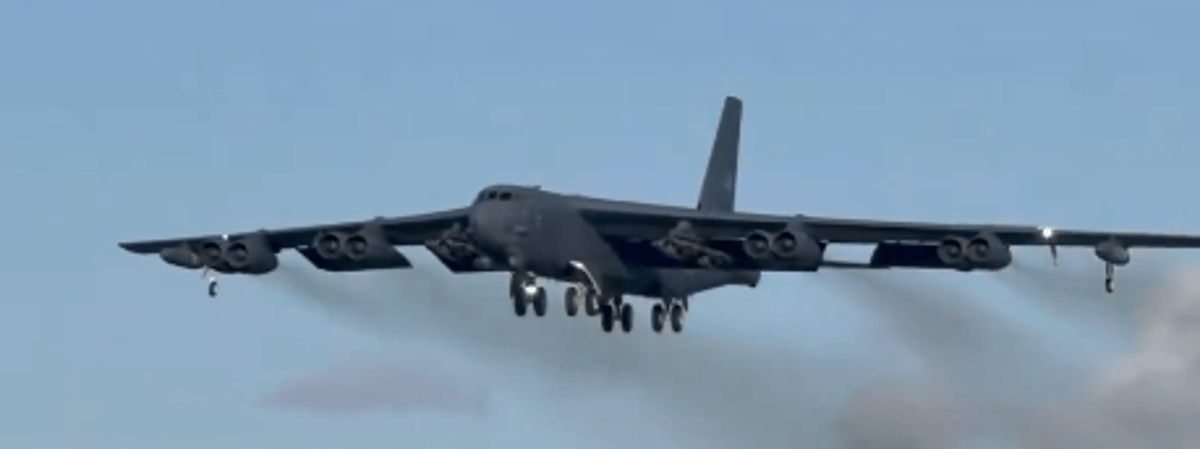
U.S. Bomber Buildup Accelerates: Two More B-52s Land at RAF Fairford | WATCH
23 Bombers, One Message: The U.S. accelerates its heavy bomber buildup in England as B-52s arrive at RAF Fairford for long-range strikes against Iran. With JDAMs and JASSM missiles ready, Washington prepares for a prolonged campaign in the Middle East.

The United States has quietly ramped up its heavy bomber presence in Europe, with two additional U.S. Air Force B-52 Stratofortress bombers touching down at RAF Fairford in England today. Military aviation spotters and live tracking accounts confirmed the arrivals in real time, pushing the total number of strategic bombers at the base to 23.
The latest arrivals continue a rapid buildup that began in early March as part of the ongoing U.S.-Israel air campaign against Iran, dubbed Operation Epic Fury.

RAF Fairford, one of the few bases in Europe capable of handling the massive B-52s, is now serving as the primary launch pad for long-range strikes deep into Iranian territory. The aircraft are loaded with JDAM precision-guided bombs and JASSM cruise missiles, enabling round-trip missions without relying on more vulnerable forward bases in the Middle East. Pentagon sources say the surge is designed to establish and maintain air superiority while keeping pressure on Tehran’s regime.
Aviation watchers report constant activity at the base, with frequent takeoffs and landings shaking nearby homes, clear signs of sustained combat operations. UK Prime Minister Keir Starmer approved expanded use of Fairford for these missions after initial hesitation, describing them as “defensive measures” against Iranian threats.
The acceleration comes as Washington signals it is prepared for a prolonged campaign. With 23 heavy bombers now forward-deployed, the U.S. has stacked unprecedented long-range strike power just hours from Iranian targets, sending a clear deterrent message to the Islamic Republic and its proxy network.
No official comment has been issued by the Pentagon on today’s arrivals, consistent with the low-profile nature of the deployment. However, defense analysts note that the scale of the buildup far exceeds routine training rotations and points to a heavier phase of operations ahead.