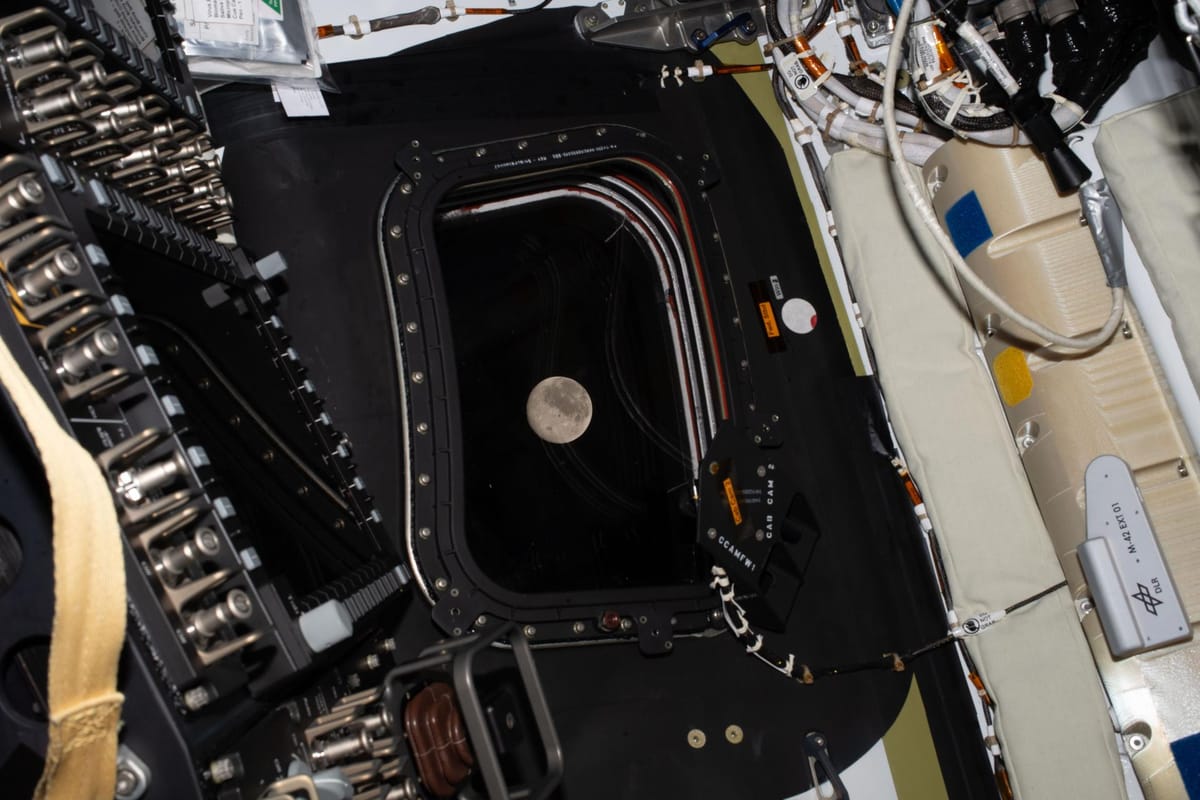
The crew of NASA’s Artemis II mission crossed a major milestone Monday, entering the Moon’s gravitational sphere of influence as they prepare for the first crewed lunar flyby in more than 50 years.
The Orion spacecraft reached the tipping point at around 04:42 GMT, when the Moon’s gravity began exerting a stronger pull on the capsule than Earth’s. At that moment, the crew was roughly 39,000 miles from the Moon and about 232,000 miles from Earth, according to NASA.
The maneuver sets up a sweeping loop around the Moon that will send the astronauts farther from Earth than any humans have ever traveled.
The four-person crew includes three Americans and one Canadian. Victor Glover is set to become the first person of color to travel around the Moon, while Christina Koch will be the first woman to do so. Canadian astronaut Jeremy Hansen will be the first non-American to make the journey.
As the spacecraft approaches the Moon, astronauts have already begun observing lunar features with the naked eye that were previously only seen through cameras. NASA released an image showing the Orientale basin, a massive crater formation sometimes described as the Moon’s “Grand Canyon,” now visible directly to the crew.
“This mission marks the first time the entire basin has been seen with human eyes,” NASA said.
During the flyby, the astronauts will document the lunar surface and conduct a series of technical tests. These include evaluating life-support systems aboard Orion and testing the crew’s emergency suits, which are capable of providing breathable air for up to six days.
The mission will also include a rare visual event: a solar eclipse as seen from lunar orbit, when the Moon blocks the Sun and reveals the outer corona.
Although Artemis II will not land on the Moon, it is a critical step in NASA’s broader plan to return humans to the lunar surface later this decade. The data collected during the mission will help inform future flights, including a planned landing mission in the coming years.
For now, the focus is on the flyby itself, a moment that reconnects human spaceflight with a destination last visited in 1972, and pushes it further than ever before.