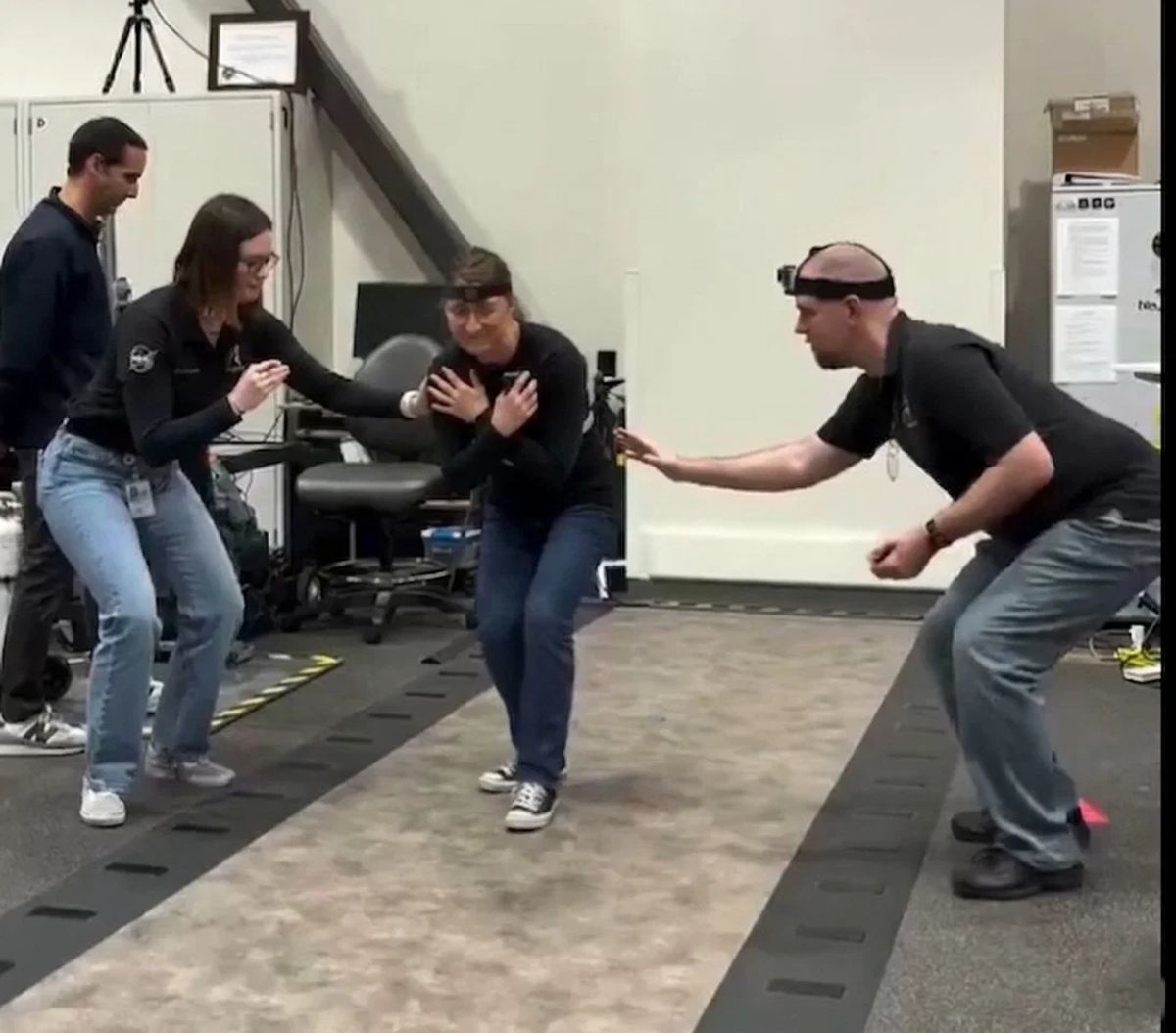
Christina Koch, the record-breaking astronaut and mission specialist for the historic Artemis 2 mission, is currently facing her toughest challenge yet: walking on Earth. Following a mission that took humans 406,771 kilometers away, the furthest point ever reached from our planeta viral video has revealed the dramatic physical toll of returning to gravity.
The "Flap-Foot" Phenomenon
Despite the flawless mission success and a splashdown in the Pacific Ocean on April 11, 2026, Koch's transition back to Earth’s gravity has been a physical ordeal.
In the widely shared footage, Koch is seen attempting her first steps, supported heavily by a medical team. She appears to have "forgotten" the basic mechanics of walking. Scientists explain that in space, the brain learns to ignore balance signals from the inner ear, relying solely on vision. Upon returning to Earth, the brain must "re-learn" how to interpret gravitational signals, making a simple straight-line walk nearly impossible in the initial days.
The Toll on the Human Body
The rehabilitation process highlights that even a relatively short ten-day mission leaves a deep mark on the human body:
- Bone Density: In microgravity, bones lose between 1% and 1.5% of their density every month.
- Muscle Atrophy: Despite rigorous daily exercise in orbit, muscles weaken significantly, leading to a temporary collapse of the musculoskeletal system’s efficiency upon reentry.
Concerns for Future Mars Missions
Koch’s difficult recovery is raising eyebrows at NASA. While Artemis 2 was a ten-day journey, a mission to Mars is expected to last over 300 days.
NASA scientists are concerned that astronauts landing on the Red Planet may suffer from such extreme bone loss, vision impairment, and physical deterioration that they might be unable to perform their duties upon arrival. While NASA’s Human Research Program (HRP) continues to study these effects, Koch’s hesitant steps serve as a stark reminder that the human body remains the greatest obstacle to deep-space exploration.