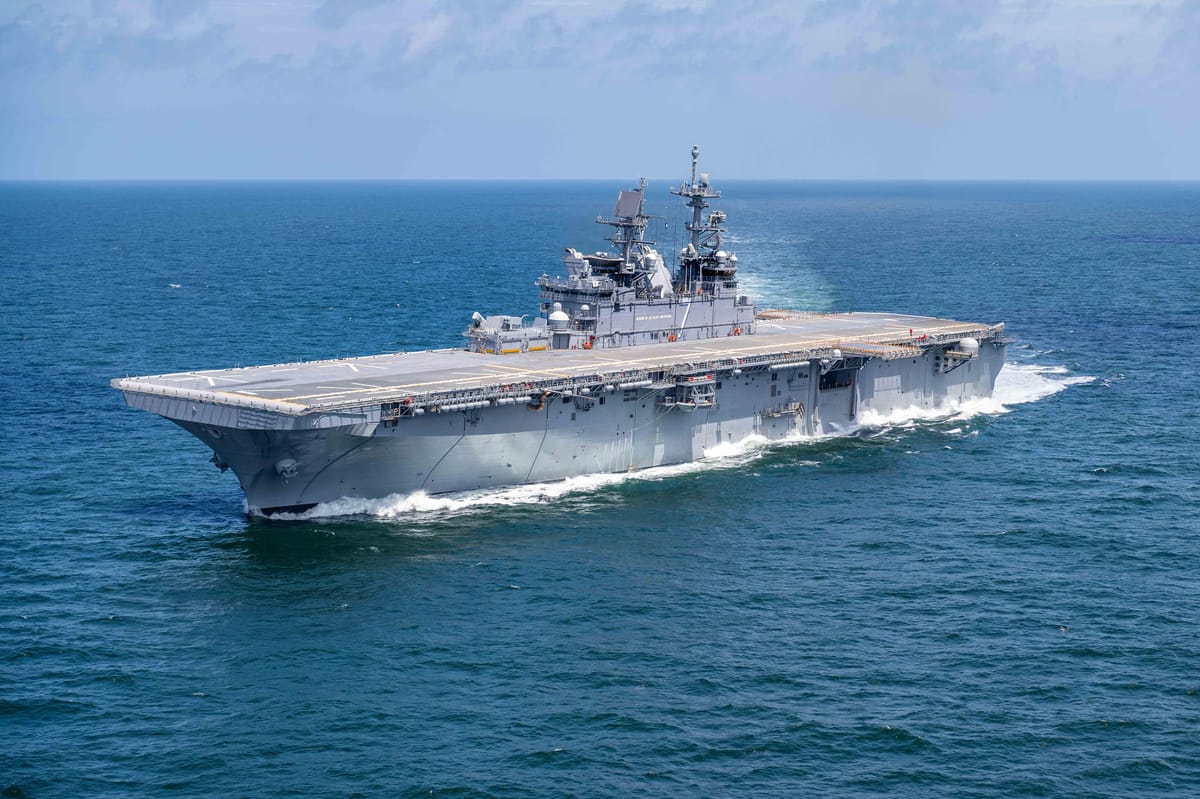
Open-source intelligence (OSINT) reports and official U.S. Navy updates confirm that the America-class amphibious assault ship USS Tripoli (LHA-7), carrying approximately 2,500 Marines from the 31st Marine Expeditionary Unit (MEU), is conducting a high-speed transit toward the Middle East amid escalating tensions in the region.
This movement follows Pentagon orders issued around March 13, directing the Tripoli Amphibious Ready Group (ARG) to reinforce U.S. forces near Iran.
Satellite imagery from March 14–15 shows the Tripoli entering the South China Sea after departing Sasebo, Japan, proceeding at speeds of 18–20 knots, indicative of a rapid deployment rather than routine operations. Positions reported include approximately 678 km from Manila on March 15, aligning with a southwest trajectory toward the Strait of Malacca and onward to the Indian Ocean. By March 16, tracking from Chinese satellite firm Mizar Vision placed the vessel near 109.6°E, 7.9°N, covering over 400 nautical miles daily.
The Tripoli is accompanied by elements of its ARG, including the San Antonio-class amphibious transport docks USS New Orleans (LPD-18) and USS San Diego (LPD-22). Some OSINT reports describe the escorts as two Arleigh Burke-class destroyers, but official U.S. Navy tracking confirms the accompanying vessels are the LPDs, which provide amphibious support rather than dedicated destroyer-level air and missile defense. This discrepancy likely stems from visual misidentification in satellite imagery. The group carries around 20 F-35B Lightning II jets, MV-22 Ospreys, and attack helicopters, enhancing its offensive and defensive capabilities.
The deployment is part of broader U.S. efforts to bolster forces in the Middle East, to secure commercial shipping through the Strait of Hormuz. The mission focuses on deterring Iranian threats, including potential blockades or attacks on tankers, with the ARG providing options for ground operations, coastal assaults, or escort duties if needed.