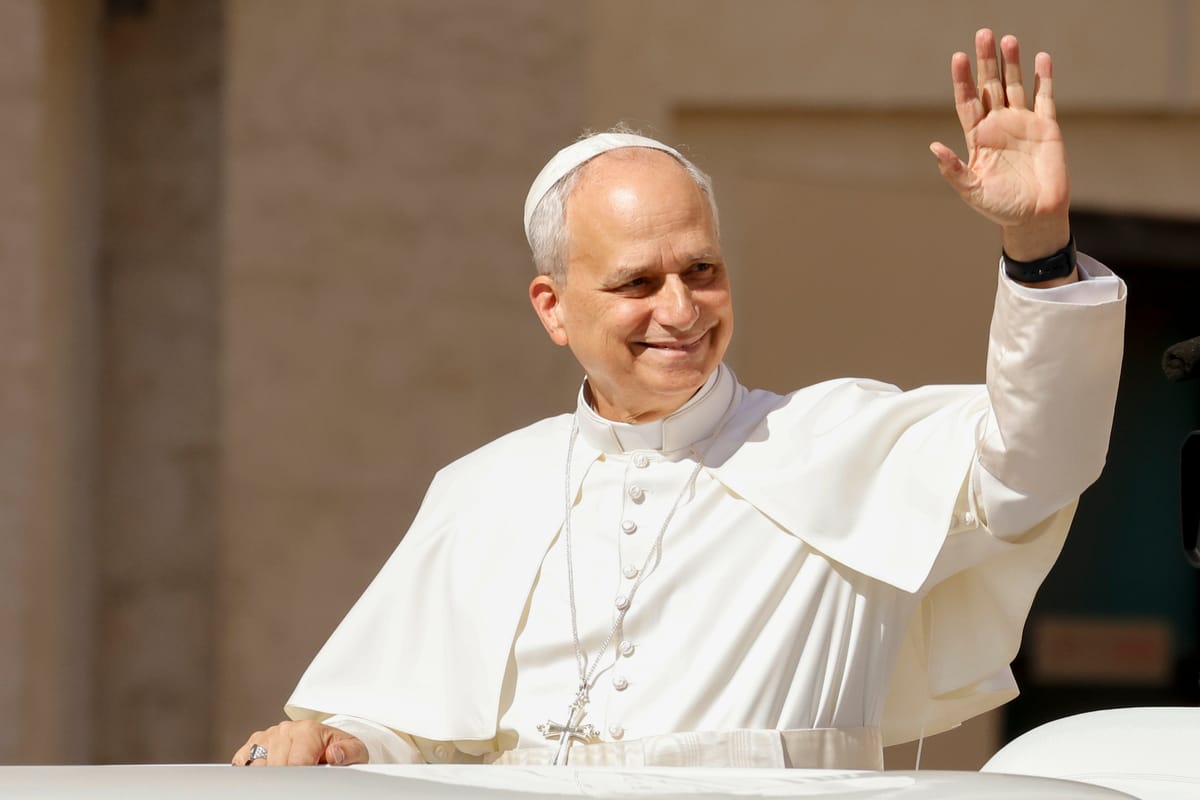
Pope Leo's Bizarre Move Sparks Global Fury
Amid an active war, Pope Leo XIV has bestowed the Vatican's highest diplomatic honor on the Islamic Republic's envoy. Critics say it validates a regime that murders Christians, kills protesters by the thousands, and fires missiles at Western allies.

In a move that has ignited controversy across religious, political, and human rights circles, Pope Leo XIV has decorated Iran's ambassador to the Vatican with the most prestigious diplomatic honor the Holy See can confer.
Pope Leo XIV has awarded the Grand Cross of the Pontifical Order of Pius IX, the highest active diplomatic distinction of the Vatican, to the ambassador of the Islamic Republic of Iran to the Holy See, Mohammad Hossein Mokhtari. The decision was confirmed by a diploma dated May 8 and signed by Cardinal Pietro Parolin, Secretary of State.
The honor raises the Iranian envoy to one of the most senior classes of the highest active papal order, founded in 1847 by Pope Pius IX and conferred today on senior diplomats and heads of state.
The timing could hardly be more charged. The award was issued in the same week that Trump declared the U.S.-Iran ceasefire "on life support," called Tehran's latest peace proposal "garbage," and signaled openness to renewed military action.
Is This Routine Protocol - or a Political Statement?
The Vatican and some observers have been quick to note that the honor is not technically unprecedented. Although the award is usually part of Vatican diplomatic protocol and is typically granted to ambassadors accredited to the Holy See after several years of service, the geopolitical context and the Pope's recent statements on the conflict with Iran have turned the gesture into a subject of strong debate. Mokhtari presented his credentials to Pope Francis in December 2023, making the two-and-a-half-year timeline broadly consistent with custom.
But Iranian state media is not treating this as a routine retirement honor. PressTV and the West Asia News Agency are running the certificate alongside images of Mokhtari with Pope Leo XIV, framing the medal as a counter-signal from the Pope against the U.S.-Israel war with Iran.
According to the Iranian embassy, the honor was bestowed upon the envoy at a time when Pope Leo XIV has recently taken firm stances condemning the actions of the United States and Israel against Iran. These positions are seen as being closely linked to the ongoing efforts of the Iranian embassy in the Vatican to promote messages of peace, justice, and opposition to warmongering.
In other words: even if Rome sees this as protocol, Tehran is reading it as endorsement.
Who Is the Regime Being Honored?
The deepest anger concerns not the diplomatic technicalities but the nature of the state being decorated.
In January 2026, Iran massacred over 30,000 pro-democracy protesters. The Center for Human Rights in Iran reported the arrests of over 53,000 people, including 555 children.
The regime's treatment of Christians is particularly pointed given that the honor comes from the head of the Catholic Church. "In 2024 alone, Christian converts in Iran received a combined 263 years in prison and thirty-seven years in internal exile for crimes directly related to the practice of their faith," exiled Iranian Crown Prince Reza Pahlavi wrote in a letter to the Pope, stressing that this represented "nearly a sixfold increase in sentencing length compared to 2023."
Pahlavi had written Leo a personal letter on Christmas Eve begging him to speak up for Christians being imprisoned, flogged, and threatened with execution by the Iranian regime. The Vatican never answered.
Then, months later, came a papal knighthood for the regime's envoy.
A Cascade of Condemnation
The reaction from critics has been swift and fierce.
Belgian parliamentarian Darya Safai called the award "surreal and deeply disturbing," saying that Christianity is supposed to stand for freedom.
A Times of Israel commentary captured the biting irony: "The Vicar of Christ 0 the shepherd of the global flock - had nothing to offer Christians being imprisoned and whipped by the very regime he was now rushing to shield." It noted that the Pope who declared he had "no fear of the Trump administration" apparently feared the theocracy too much to write a single word in response to Pahlavi's Christmas Eve letter about Christians in Evin Prison.
Damian Thompson, associate editor of The Spectator and a Catholic journalist who typically supports Leo, wrote that "Pope Leo makes no reference to the Iranian regime's cold-blooded slaughter of thousands of its citizens." Catholic writer John Zmirak went further: "If I were an Iranian Christian enduring that country's evil regime, I'd feel utterly betrayed."
Vatican journalist Franca Giansoldati warned that Leo had "completely ignored" Iran's repression "as if it does not exist," and that his silence "seems to follow the very cautious and fearful line of his predecessor Bergoglio, who always pretended not to see even the long trail of blood of thousands and thousands of girls, mostly students, brutally massacred, raped, often hanged by the Ayatollah regime."
The Pope's Broader Anti-War Stance
Pope Leo has been unambiguous about his view of the conflict that began on February 28, 2026. Leo amplified his condemnation of the U.S.-Israeli war with Iran, saying "God does not bless any conflict" and certainly doesn't side with those who drop bombs. He told the bishops of the Chaldean Catholic Church that no cause can justify the spilling of innocent blood.
Trump attacked the pope as "weak on crime and soft on foreign policy," while JD Vance, a converted Catholic, also criticized Leo, telling him to "stay out of politics."
The Pope, for his part, has not blinked. Aboard his return flight from Africa, Leo firmly condemned the killing of protesters in Iran when directly challenged by reporters, saying: "When a regime, when a country takes decisions which takes away the lives of other people unjustly, then obviously that is something that should be condemned."
Vatican's Defense: Dialogue, Not Endorsement
Defenders of the Vatican argue that its diplomatic instrument is not moral approval; it is the language by which the Church identifies its negotiating partners and signals that a door of dialogue remains open. Pope Leo XIV has separately condemned Iran's killing of its own protesters.
As Cardinal Parolin recently recalled, the Vatican's position on the Iranian nuclear program has not changed and maintains the historical line of opposition to nuclear weapons.
Whether those distinctions satisfy critics is another matter. For many, from human rights advocates to persecuted Iranian Christians to American conservatives, the image of the Vatican's highest medal hanging around the neck of a representative of the Islamic Republic is simply too much to absorb on its own diplomatic terms.
As one critic wrote: the regime represented by the newly decorated ambassador had murdered thousands of its own citizens just months ago. None of those victims will be receiving papal honors.