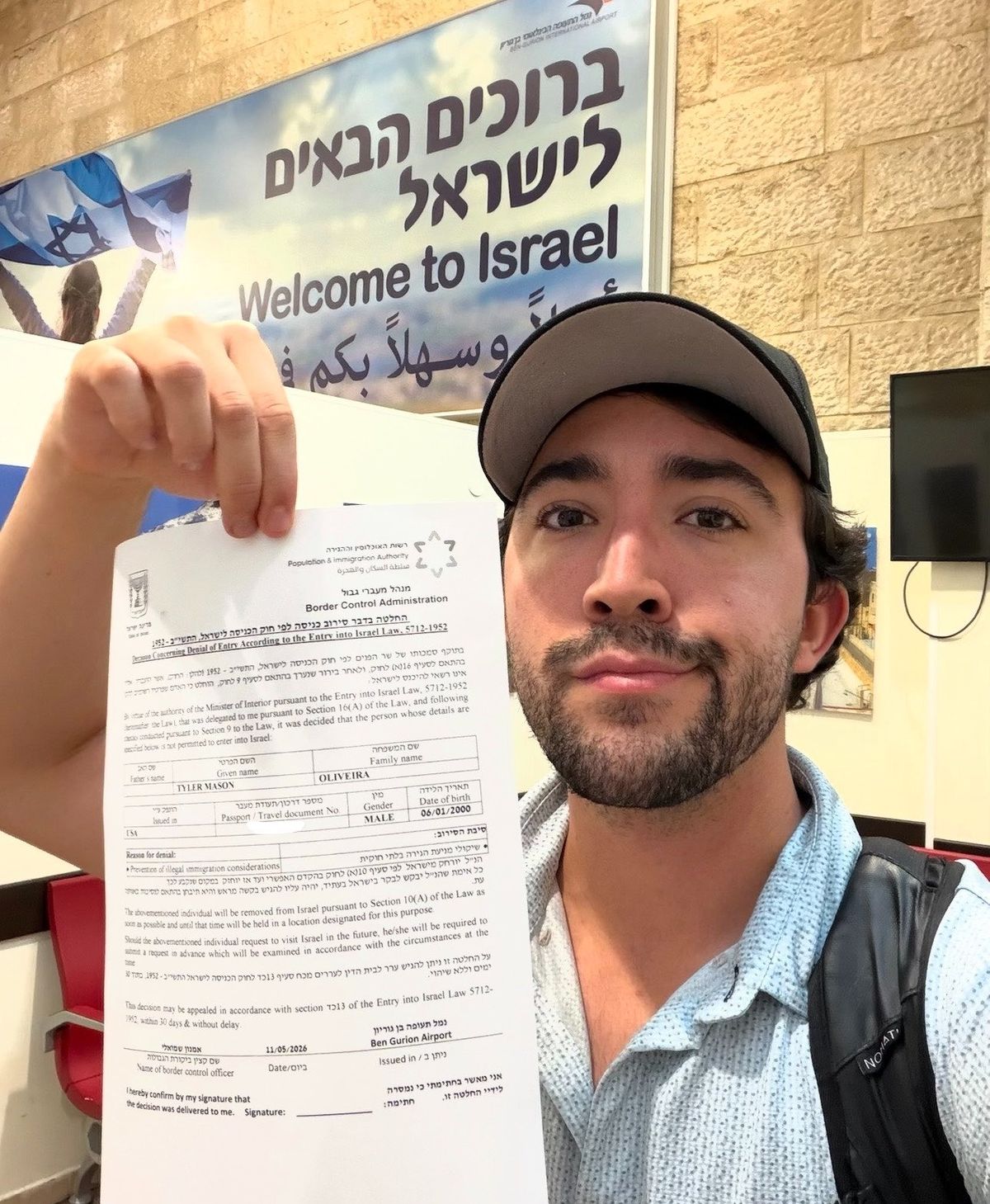
Israel denied entry to American YouTuber Tyler Oliveira after he landed at Ben Gurion Airport, following a recommendation from Diaspora Affairs and Combating Antisemitism Minister Amichai Chikli.
Oliveira, a popular online personality with millions of followers, was stopped during border control questioning and refused entry into the country. According to Israel’s Diaspora Affairs Ministry, the decision was based on online activity that officials said went beyond legitimate freedom of expression and included inciting statements against Jews, as well as content with antisemitic characteristics.
Chikli defended the move, saying that Israel would not allow those seeking to spread hatred to operate freely inside the country. The minister said that anyone arriving in Israel with the goal of promoting antisemitic content, supporting boycotts, or inciting against the Jewish people would be turned away.
The ministry cited several examples from Oliveira’s recent content, including videos and interviews focused on Orthodox Jewish communities in the United States. Officials said his material portrayed Jewish communities through hostile stereotypes, including claims that Jews exploit public generosity, manipulate Holocaust memory, take over neighborhoods, and operate in ways compared to organized crime.
Israeli officials said the denial of entry was made under the Entry into Israel Law, following coordination between government bodies and the Population and Immigration Authority. The ministry said advance information indicated Oliveira was expected to arrive in Israel, and that the recommendation to deny his entry was made before he landed.
Oliveira has gained attention online for documentary style videos and street interviews, but his recent content about Jewish communities in New York and New Jersey has drawn growing criticism from Jewish leaders and Israeli officials, who say it promotes antisemitic narratives under the cover of social commentary.
The decision marks a more aggressive Israeli stance toward foreign online personalities accused of spreading antisemitic content. For Israel, the case was not treated as a routine political disagreement, but as an attempt by a high profile influencer to enter the country after building a public platform around material officials described as hostile to Jews and Israel.