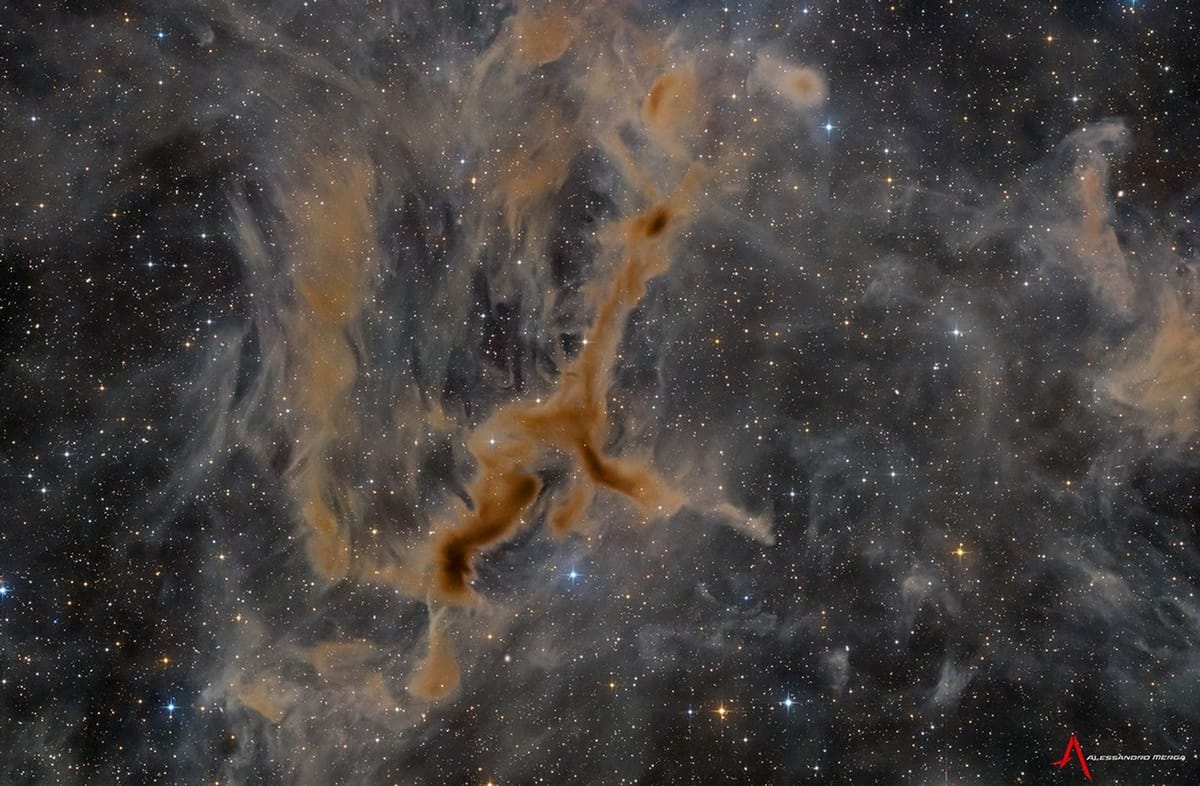
NASA has unveiled a breathtaking image of LDN 1295, a dark nebula nicknamed the "Giraffe Nebula" for its remarkable shape, as part of its Astronomy Picture of the Day (APOD) project. The photograph captures a dark, elongated structure that many observers say resembles a giraffe facing right, its neck stretched upward and legs seemingly frozen mid-stride. NASA notes with a touch of humor that others manage to see a squirrel instead.
Located in the direction of the Cassiopeia constellation, the nebula belongs to the Lynds catalog of dark nebulae. American astronomer Beverly Lynds published the catalog in 1962 after researching and mapping hundreds of dark dust clouds across the night sky.
Unlike the colorful, glowing nebulae familiar from space photography, a dark nebula doesn't necessarily emit prominent light. It's an interstellar cloud composed of gas and dust whose particles block visible light from stars behind it. The result is a dark patch against a dense field of stars, sometimes taking on shapes that appear almost familiar to the human eye. Because of their dim nature, nebulae of this type also pose a significant challenge for astrophotographers.
But why do we see a "giraffe" in a dust cloud located at vast distances from Earth? NASA explains that this is a psychological phenomenon known as pareidolia, the human brain's tendency to identify figures, faces and familiar shapes in random structures. It's the same phenomenon that makes us see faces in clouds, figures in rocks or features on the moon's surface.
The image was captured by astrophotographer Alessandro Merga and selected as NASA's Picture of the Day. It demonstrates how cold, dark dust clouds, which typically hide the universe from our view, can themselves become one of the most intriguing and picturesque sights in the night sky.