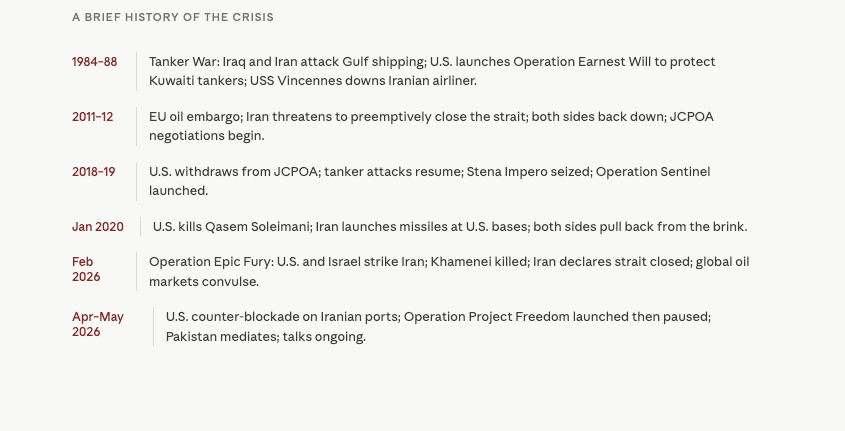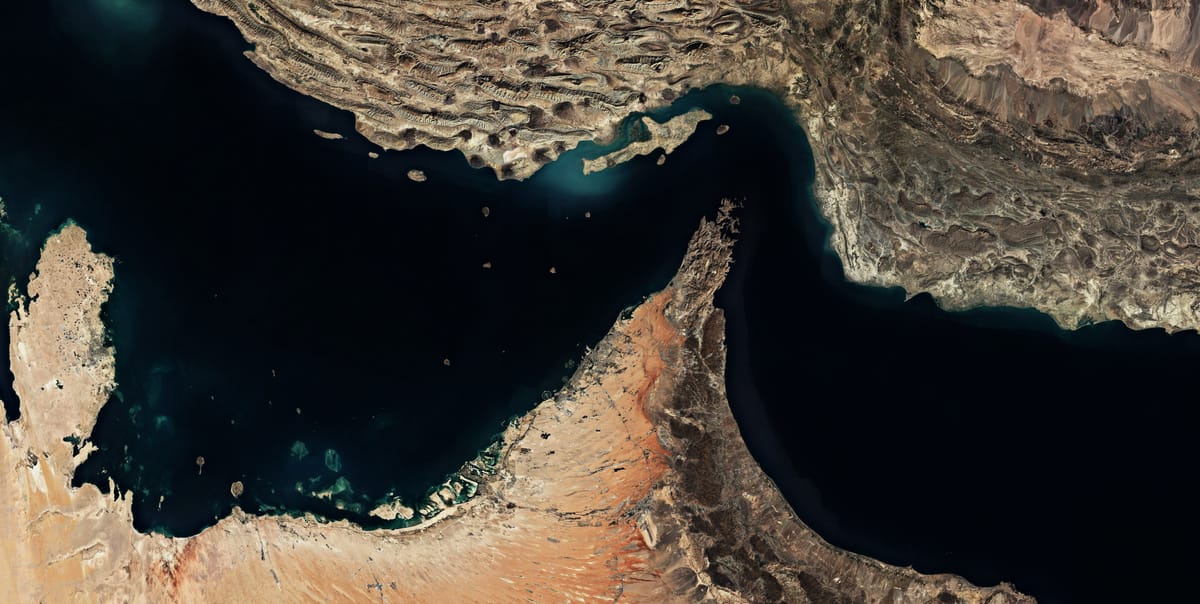
On the morning of February 28, 2026, American and Israeli aircraft struck Iran in a coordinated campaign called Operation Epic Fury. Within days, Iranian forces had declared the Strait of Hormuz closedת a 21-mile channel between the Iranian coast and the Omani peninsula of Musandam, through which roughly a fifth of the world's seaborne oil had quietly flowed for decades. Gasoline prices in the United States have since risen more than 50 percent. Hundreds of ships sit stranded. And the world watches a game of naval brinkmanship that feels, to many, terrifyingly new.
It is not new. Not even close.
The threat to close the Strait of Hormuz has been Iran's trump card, long before Donald Trump was a presidentת since the 1970s. To understand why the crisis keeps returning, and why it never quite resolves, is to understand something essential about the geography of oil, the paranoia of great powers, and the peculiar pride of a nation that sits astride the most consequential bottleneck on earth.
The geography of leverage
The Strait of Hormuz is a crescent-shaped sliver of water connecting the Persian Gulf to the Gulf of Oman and, beyond it, the Arabian Sea. Iran sits on one shore. Omanת politically neutral and quietly essential, sits on the other. The navigable shipping channels are barely two lanes wide in global terms: two inbound, two outbound, separated by a thin median zone.
This pinch point is why the Persian Gulf matters at all. Strip it away and Kuwait, Qatar, Bahrain, the UAE, and southern Iraq become maritime dead ends. Saudi Arabia's eastern fieldsת the largest conventional oil reserves on earthת lose their only efficient exit. Qatar's liquefied natural gas, which heats homes across Europe and Asia, has nowhere to go.
Iran has always known this. It has lived with this knowledge the way a small nation lives next to a powerful neighbor: carefully, resentfully, and with one hand on the weapon it cannot afford to use but cannot afford to put down.
The tanker war, 1984–1988
The first time the strait became a shooting gallery was during the Iran-Iraq War, a grinding eight-year conflict that killed perhaps a million people and reshaped the Middle East. By 1984, both sides had begun targeting oil tankers, Iraq to strangle Iran's export revenues, Iran to punish Gulf states backing Saddam Hussein's war machine.
By 1987, Iranian mines and Revolutionary Guard speedboats had made the Gulf genuinely dangerous. Kuwait, alarmed, asked both the Soviet Union and the United States to reflag its tankers, a clever move that forced Washington's hand. The Reagan administration agreed, partly from Cold War anxiety about Soviet inroads.
Operation Earnest Will began in July 1987. U.S. Navy warships escorted Kuwaiti tankers through the Gulf in the largest convoy operation since World War II. It was not bloodless. The USS Stark was struck by Iraqi Exocet missiles, killing 37 American sailors, in a friendly-fire incident that America chose not to escalate. The USS Samuel B. Roberts hit an Iranian mine. In retaliation, the U.S. launched Operation Praying Mantis in April 1988, destroying two Iranian oil platforms and sinking several Iranian vessels. It was the largest surface naval battle the United States had fought since 1945.
"The strait has never been just a shipping lane. It has always been a political instrument and Iran has always known how to play it."
Then, on July 3, 1988, the USS Vincennes shot down Iran Air Flight 655, killing all 290 people aboard. Iran called it deliberate murder. The U.S. called it a tragic misidentification. The truth, that a warship crew under stress in a crowded strait fired at what its systems had classified as an attacking fighter, said something uncomfortable about what happens when great navies and small waterways collide. Iran accepted a ceasefire with Iraq two weeks later. Many historians believe the downing of the airliner, and the demonstration that America would fight, was the decisive factor.
The threat becomes ritual, 1990s–2010s
After the Islamic Republic survived the tanker war and the ceasefire with Iraq, the strait settled into a new role: threat theater. Iranian commanders issued warnings about closing Hormuz with such regularity that the statements became almost formulaic. Western analysts began calling it "the Hormuz card" - something Tehran played rhetorically whenever it felt cornered, without ever quite playing it in full.
The pattern was consistent. Sanctions tightened. Iran threatened to close the strait. Oil prices spiked. Diplomats scrambled. Then the crisis eased without anyone having to test whether Iran could actually do what it claimed.
The 2011–2012 standoff was the closest the ritual came to breaking down. The European Union imposed an oil embargo. Iran's parliament debated legislation to block the strait preemptively. The aircraft carrier USS John C. Stennis transited the strait as a demonstration. Iranian state television broadcast speedboat exercises showing swarms of small craft attacking a mock carrier. Both sides blinked, eventually, and the JCPOA nuclear deal, signed in 2015, gave the pattern a longer pause than usual.
But the underlying logic never changed. Iran could not permanently close the strait, doing so would devastate its own economy, since it exports oil through the same channel. What it could do was threaten to close it, impose costs on commercial shipping through mines and harassing tactics, and raise the price of doing business in the Gulf until the political calculus shifted in its favor. This is asymmetric leverage at its most elegant: the ability to impose costs without bearing them equally.
2019: The shadow war
When the Trump administration withdrew from the JCPOA in 2018 and reimposed sanctions, the pattern resumed with new intensity. In the summer of 2019, six tankers were attacked near the strait in circumstances that U.S. officials attributed to Iran. The British-flagged Stena Impero was seized by Revolutionary Guard speedboats and held for two months, a direct echo of the 1980s, updated with drone footage and social media. The U.S. assembled a maritime coalition it called Operation Sentinel. Britain, Australia, and a handful of Gulf states participated. Iran called it provocation. The strait stayed open, barely.
The killing of Qasem Soleimani by U.S. drone strike in January 2020 raised the temperature to its highest point since 1988. Iran launched ballistic missiles at U.S. bases in Iraq. For 72 hours the region held its breath. Then both sides stepped back. The strait remained open.